Az Internet Explorer kereső egy régebbi verzióját használja. Az optimális megjelenítés érdekében kérjük, frissítse keresőjét.
“Robot safety no longer ends at the safety fence.”
Industrial robots are increasingly networked, software-based, and integrated into complex production environments. This opens new possibilities but also presents companies with new challenges in terms of safety, cybersecurity, and compliance. With ISO 10218:2025, the international safety standard for industrial robots and robotic systems has undergone its first major update since 2011. At the same time, European regulations, such as the Machinery Regulation and the Cyber Resilience Act, are changing the regulatory framework. In this interview, André Hetzke, Product Compliance Consultant at KUKA, and Stefan Schleipen, Chief Software Architect at KUKA, explain what companies need to know now, what role software plays in this context, and how KUKA supports its customers on the path to safe and future-proof automation.
2026. november 12.
Why was ISO 10218 revised, and what has changed compared to the 2011 edition?
André Hetzke: Since 2011, industrial robotics – including mobile robotics – has advanced significantly. Today, robots are more interconnected, are increasingly configured via software, and collaborate more closely with other machines, digital systems, and people. ISO 10218:2025 reflects this technological shift and the current state of the art.
The new edition clarifies existing requirements and introduces additional safety functions. These include, among other things, expanded requirements for safe speed monitoring, manual operation at high speed T2, the single point of control, and start and restart interlocks. In addition, new safety functions have been introduced, such as the “Normal Stop”.
One of the most important changes is that cybersecurity is now explicitly considered part of robot safety – for both 6- and 7-axis robots as well as mobile robotics. If cyber threats can affect safety-related functions, these risks must be assessed and appropriate protective measures put in place. This marks the first time that functional safety and cybersecurity have been so closely linked.
Industrial robots are increasingly networked, software-based, and integrated into complex production environments.
Who is affected by ISO 10218:2025, and what specific actions must companies take?
André Hetzke: The standard applies to manufacturers of industrial robots, system integrators, and operators. Each party has a different responsibility: The manufacturer is responsible for the robot product, the integrator for the safe design and conformity of the complete robot system, and the operator for safe operation and the controlled management of changes to the system.
Companies should first distinguish between three situations:
For new systems, it must be determined which legal, normative, and contractual requirements apply at the time of placing on the market or commissioning.
For existing systems, it is important to document which control and software versions are in use and what changes are planned for the future.
For retrofits, it must be determined whether new hazards arise or existing risks are increased.
In addition, companies should take into account the requirements of their target markets and customer contracts. ISO 10218 is applicable internationally but is regionally adapted, for example as EN ISO 10218 in Europe or via ANSI/A3 R15.06 in the U.S. Customers may also already require compliance with the new standard through requirements specification or contracts.
Are existing robotic systems affected, and when is a new risk assessment required?
André Hetzke: Existing systems do not need to be replaced or completely reassessed solely because a new standard has been published, since they have already been placed on the market. In principle, they can continue to be operated as long as they are safe, properly maintained, and not significantly modified. Even replacing a component with a newer version, performing a repair, using replacement parts, or simply improving the user interface does not, as a rule, automatically constitute a significant modification. A new or supplementary risk assessment becomes necessary when changes are made to the system. In particular, the following must be examined:
Are new hazards arising?
Are existing risks increasing?
Can these risks be sufficiently reduced through existing or simple additional protective measures?
Do the intended use or essential functions of the equipment change?
The integration of additional machinery, new technologies, or new safety functions, for example, may require a more detailed assessment. However, whether a significant change has occurred must always be assessed on a case-by-case basis.
If a system undergoes a significant modification, it must be treated as a new product, and a new conformity assessment procedure is required. This also entails a new CE marking, a new declaration of conformity, and updated documentation.
What requirements apply to new robot systems, and what changes when it comes to integration?
André Hetzke: With a new system, it is not only the robot that must be considered, but the entire robot system and its specific application. This includes, among other things, the controller, software, grippers, tools, peripherals, safety devices, interfaces, and connected machines.
ISO 10218-1 defines the requirements for industrial robots as partly completed machinery, while ISO 10218-2 addresses robot systems, robot applications, and the integration of robot cells. A robot that complies with the standard alone does not, therefore, constitute a fully compliant system.
With its new iiQKA.OS2 operating system and the KR C5 controller platform, the robot system has been certified to Security Level 2 according to IEC 62443-4-2 and already meets the requirements of Regulation (EU) 2024/2847 Cyber Resilience.
Integrators should clarify the following at the beginning of a project:
Which regulations and standards apply in the target market?
What requirements are specified in the requirements specification?
What safety functions and performance levels are required?
How will external machines and safety devices be integrated?
What software and network interfaces are planned?
Who is responsible for the conformity assessment of the entire system?
What does the standard mean for collaborative applications and cobots?
André Hetzke: A Cobot —a term that, incidentally, is not defined in the standard but was coined by the industry— is not automatically a safe collaborative application. The standard addresses industrial robots, which include cobots and accordingly are treated under regulations. Whether an application can be operated without a separating protective device depends on the risk assessment of the entire system.
Among other factors, the tool, the workpiece, potential contact points, forces, pressures, speeds, motion sequences, and the specific interaction between humans and robots must be taken into account.
The updated ISO 10218 places greater emphasis on requirements for human-robot collaboration. However, the specific safe design remains the responsibility of the system integrator. The decision of “safety fence or no safety fence” must therefore not be made solely based on the robot model used.
Why does cybersecurity play such a central role in industrial automation today?
Stefan Schleipen: Industrial automation is based on increasingly interconnected components in ever more complex production facilities. Robots communicate with machines, engineering systems, service applications, and higher-level production systems. This interconnectivity creates new opportunities but can also open up additional points of vulnerability for cybercriminals.
With production facilities, it’s not just about protecting data. Cyberattacks can lead to production downtime, manipulated processes, or safety risks. If an attack can, for example, influence operating modes, motion parameters, or safety-related configurations, cybersecurity immediately becomes a matter of physical safety.
That is why functional safety and cybersecurity are increasingly converging. Functional safety protects against dangerous technical malfunctions. Cybersecurity protects systems against, among other things, unauthorized access or intentional manipulation. To ensure safe plant operation today, both areas must be considered together.
One of the most important changes is that cybersecurity is now explicitly considered part of robot safety – for both 6- and 7-axis robots as well as mobile robotics.
What cybersecurity requirements does ISO 10218:2025 specify, and how can companies protect their robotic systems?
André Hetzke: ISO 10218:2025 requires a cybersecurity threat analysis if cyber threats could affect the safe operation of the robot. If such risks are identified, appropriate measures must be put in place to protect against unauthorized access to the control system as well as to safety-critical hardware and software.
Stefan Schleipen: From a technical standpoint, this involves, among other things, controlled and authenticated access, protected communication interfaces, secure software updates, and the protection of safety-critical functions.
However, an effective security strategy encompasses more than just the product itself. Operators should appropriately segment machine and corporate networks, clearly define roles and access rights, avoid unnecessary services and connections, and secure remote access. In addition, they should follow the manufacturers’ security guidelines and establish data backup and recovery processes.
Cybersecurity is not a one-time measure taken during commissioning. It must be actively implemented and continuously developed throughout the system’s entire lifecycle.
What role do the Cyber Resilience Act, updates, and vulnerability management play?
André Hetzke: The Cyber Resilience Act, or CRA for short, establishes binding cybersecurity requirements in the EU for products with digital elements. This includes also networked industrial hardware and software products. Whether a specific product falls under the CRA must be assessed based on its functions, intended use, and possible exemptions. In the future, manufacturers must systematically address cybersecurity throughout the product lifecycle. This includes, among other things, a cybersecurity risk assessment, secure product development, technical documentation, vulnerability management, security updates, and defined reporting requirements.
The ISO 10218, the Machinery Regulation, and the CRA complement one another in this regard: ISO 10218 primarily addresses cybersecurity where it affects the functional safety of the robot and the robot system. The Machinery Regulation requires, among other things, the protection of safety-related functions against corruption. The CRA also sets comprehensive cybersecurity requirements for products with digital elements throughout their lifecycle.
Stefan Schleipen: Security updates and structured vulnerability management are therefore central components of a modern security strategy. Vulnerabilities must be continuously identified, assessed, and remedied. Relevant security information must be communicated to customers, and necessary updates must be provided.
Operators, for their part, need standardized processes to evaluate updates, test them, install them during appropriate maintenance windows, and document them in a traceable manner. In industrial plants, it is always essential to consider the potential impact an update may have on production, the application, and validated safety functions.
What security principles does KUKA follow with iiQKA.OS2 and AMR.OS 3.X?
Stefan Schleipen: Cybersecurity was not viewed as an after-the-fact add-on feature in the operating systems iiQKA.OS2 (for 6- and 7-axis robots as well as Delta and Scara kinematics) and AMR.OS 3.X (for mobile robotics), but rather as a fundamental product characteristic. This is called “Security by Design” and means that security requirements are taken into account in the architecture and development from the very beginning.
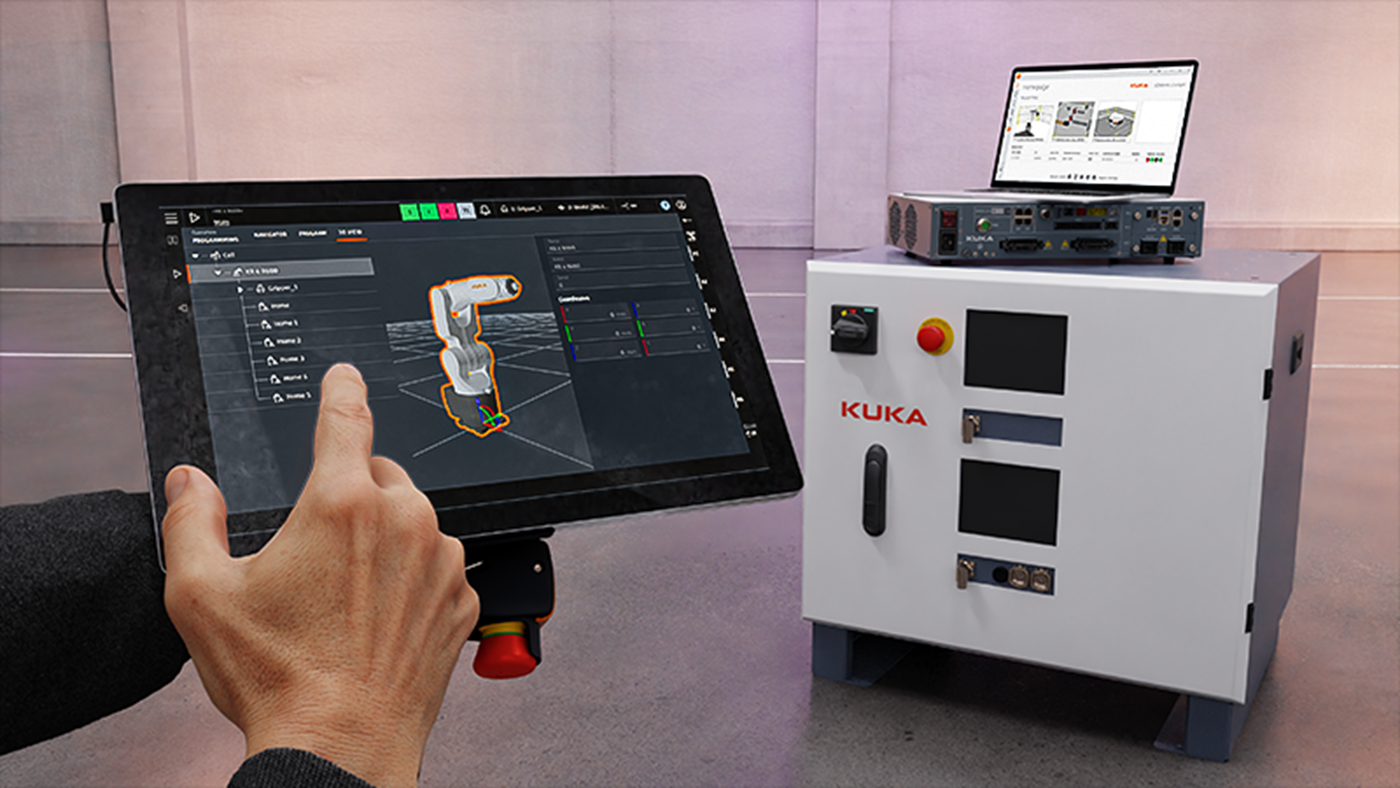
iiQKA.OS2 combines cybersecurity and performance on a single platform.
“Defense in Depth” describes a multi-layered protection concept. Even if a single component were compromised, this ensures that the entire system would not automatically be affected. The “Least Privilege” principle ensures that individual services and users are granted only the rights that are actually necessary for their respective tasks.
Specific elements include the clear separation of components within the operating systems, an authentication layer, signed software updates, and the general securing of interfaces. This reduces potential attack surfaces.
iiQKA.OS2 and AMR.OS 3.X are based on IEC 62443-4-1 for the secure development process and on IEC 62443-4-2 for the product’s cybersecurity requirements. The certification of iiQKA.OS2 to Security Level 2, SL-C 2, gives customers the assurance that they are using an independently verified solution based on an internationally recognized industry standard. The underlying processes for “Secure-by-Design,” vulnerability management, and a secure product lifecycle also make an important contribution to preparing for the CRA’s requirements.
At the same time, security should not unnecessarily restrict usability and productivity. When security mechanisms are integrated into the platform from the outset, it becomes easier to combine a high level of security with practical usability.
How does KUKA support customers during the transition, and where should companies take action now?
André Hetzke: With the KR C5-2, iiQKA.OS2, and AMR.OS 3.X, KUKA has established a clear transition path to the new generation of technology and standards. For new projects, we recommend relying directly on this latest generation of platforms.
For existing systems, however, a case-by-case assessment is required. Not every system needs to be modernized immediately. The key factors are the planned remaining service life, any planned modifications, and whether a new risk assessment or conformity assessment might be required.
iiQKA.OS2 and AMR.OS 3.X are based on IEC 62443-4-1 for the secure development process and on IEC 62443-4-2 for the product’s cybersecurity requirements.
Depending on their specific situation, KUKA Customer Service supports customers with:
system evaluations and technical consulting,
controller upgrades,
migrations from KSS to iiQKA.OS2,
retrofit and modernization solutions,
complete application migrations,
lifecycle planning,
as well as training for iiQKA.OS2.
Stefan Schleipen: Throughout the product lifecycle, KUKA also supports customers through structured vulnerability and patch management processes. Security-related vulnerabilities are assessed, customers are informed about relevant cybersecurity issues, and necessary security updates are provided.
Customers should now prioritize three areas: First, they need transparency regarding their installed robots, controllers, software versions, and network connections. Next, they should define clear responsibilities for updates, vulnerabilities, and remote access. Finally, for new installations and long-term modernizations, they should consistently rely on platforms that support “security by design” and continuous software maintenance.
Secure automation requires a holistic approach
The most important message is this: safety, cybersecurity, and compliance are no longer separate, standalone projects. They must be considered together throughout the entire lifecycle of a system. KUKA supports customers in this effort with a modern platform, internationally recognized safety standards, and tailored service, migration, and training offerings.