Você está usando uma versão antiga do navegador Internet Explorers. Para uma visualização ideal, atualize seu navegador
„Nothing out here is standardized – and that’s exactly why we need automation“
Solar fields are vast, remote – and anything but controlled industrial environments. Wind, dust, heat or freezing temperatures are part of daily operations. Yet thousands of solar modules must be installed with precision, day after day. This is why Sunstall decided to bring automation to a place where it was long considered impractical: directly into the field. Together with Cosmic Robotics and KUKA, the company has developed an approach that fundamentally redistributes work between humans and machines.
Carolin Hort
10 de agosto de 2026
Technology
Tempo de leitura: 3 minutos
When automation is discussed, the focus is often on efficiency: faster, cheaper, more output. In the case of Sunstall – a U.S.-based contractor specializing in large-scale, ground-mount solar installations – this logic falls short. Here, automation is primarily about one thing: making work predictable.
The Challenge
Solar module installation does not take place in controlled industrial environments. Solar fields are expansive, remote and exposed to constantly changing conditions. Modules often weigh more than 35 kilograms (over 80 pounds), are handled hundreds of times per day and installed in heat, cold, wind or rain.
Under these conditions, fatigue becomes the decisive variable. The process itself is defined – human physical endurance is not. As a result, external conditions introduce variability into performance and throughput.
Why efficiency alone is not enough
Automation can certainly accelerate processes. But in Sunstall’s solar field operations, the greater leverage lies elsewhere. When robots take over the most physically demanding tasks, workflows become predictable. Throughput no longer depends on how exhausted teams are after hours of repetitive heavy lifting. Predictability becomes the real productivity gain.
When robots handle the most physically demanding tasks, installation work becomes less dependent on fatigue and more predictable.
The shift in perspective
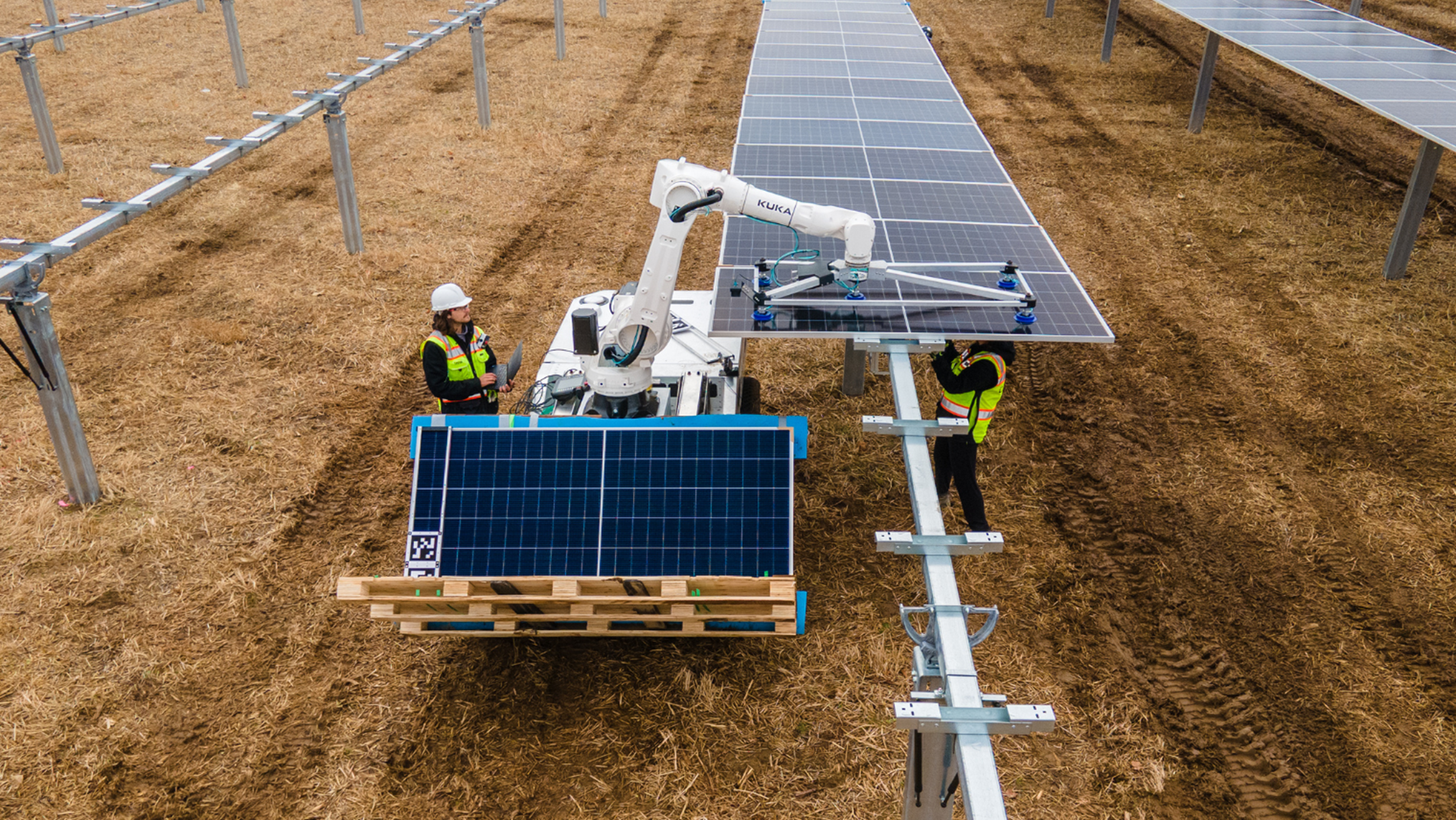
In Sunstall’s installation process, the robot lifts and places the modules. Human teams remain an integral part of the workflow: they handle alignment, fastening, quality assurance and on-site decision-making.
The difference is fundamental. Process performance is no longer tied to peaks of physical strain. The most demanding steps are buffered, allowing the overall workflow to run more evenly and reliably.
From Concept to Practice: Robotics in the Solar Field
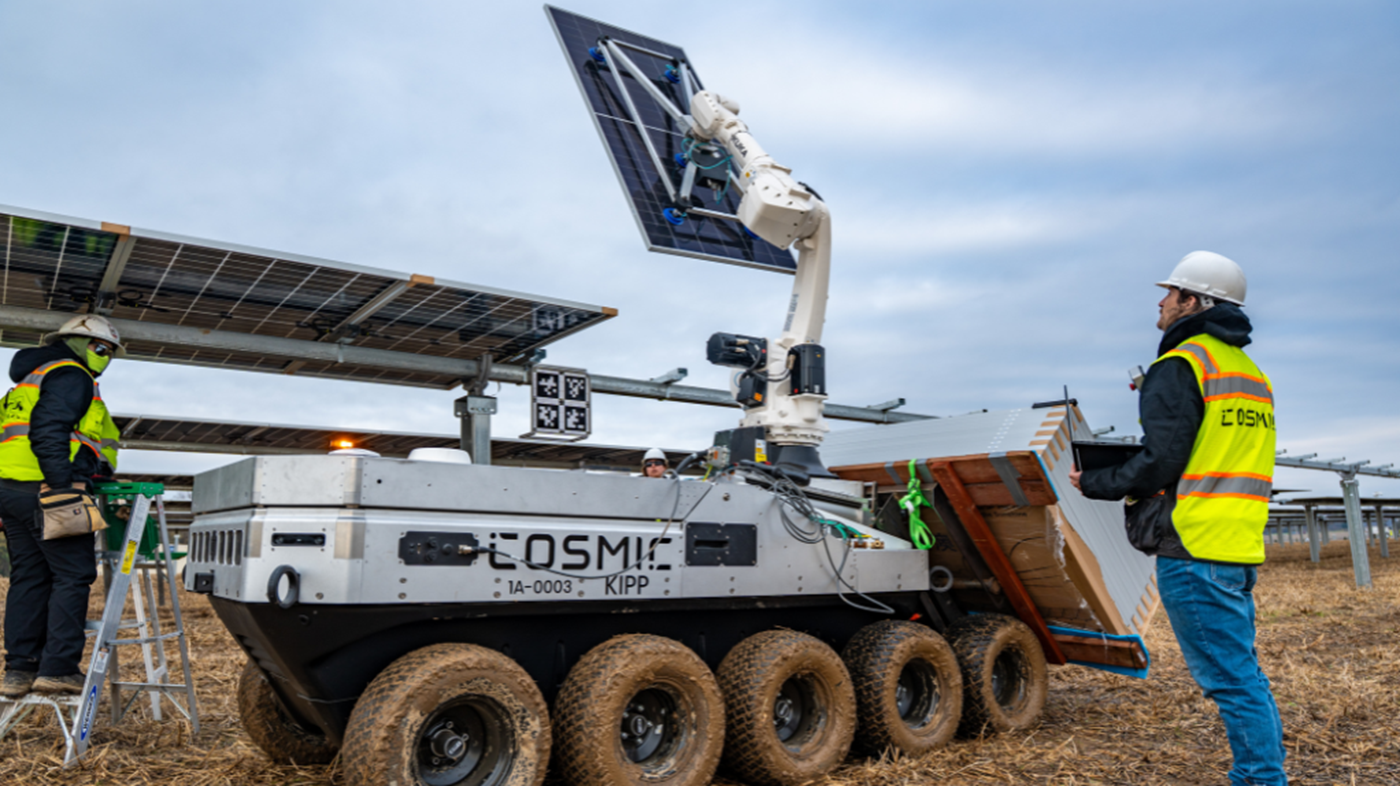
Sunstall partnered with Cosmic Robotics to deploy the Cosmic‑1A, an autonomous mobile robot designed for use in solar parks, combining a rugged all‑terrain vehicle platform with a KUKA robot arm and computer vision for panel detection. The system places solar panels precisely on the mounting structure, enabling a consistent and repeatable workflow under changing field conditions while on‑site teams remain responsible for fastening, quality assurance, and decisions.
Designed for use in solar parks, the Cosmic‑1A combines autonomous mobility, computer vision and a KUKA robot arm to place solar panels accurately and consistently in the field.
What this says about the future of automation
The solar example illustrates the value automation can deliver well beyond traditional manufacturing environments – wherever work is physically demanding, repetitive and heavily influenced by external conditions.
The decisive factor is not maximum autonomy, but robust adaptability. Systems must see, react and maintain precision even as ground conditions, positions and environmental factors continuously change.
Conclusion
Automation is not only about speed or cost. It is an answer to a broader question: how industrial work can be designed sustainably under real-world conditions. How this form of automation is implemented in the solar field – and the role mobile robotics plays in it – is shown in the Sunstall and KUKA case study.
We spoke with Philipp Kauls, Project Manager at Sunstall, about the assumptions, challenges and insights that shaped the project.
What was the most common assumption about solar installation that turned out to be wrong?
Philipp Kauls: “For a long time, we assumed that scaling installation simply meant adding more people or extending shifts. In practice, we realized that at some point planning is no longer the limiting factor – physical strain is. When modules weigh over 80 pounds and are lifted repeatedly for hours, fatigue becomes the decisive constraint.”
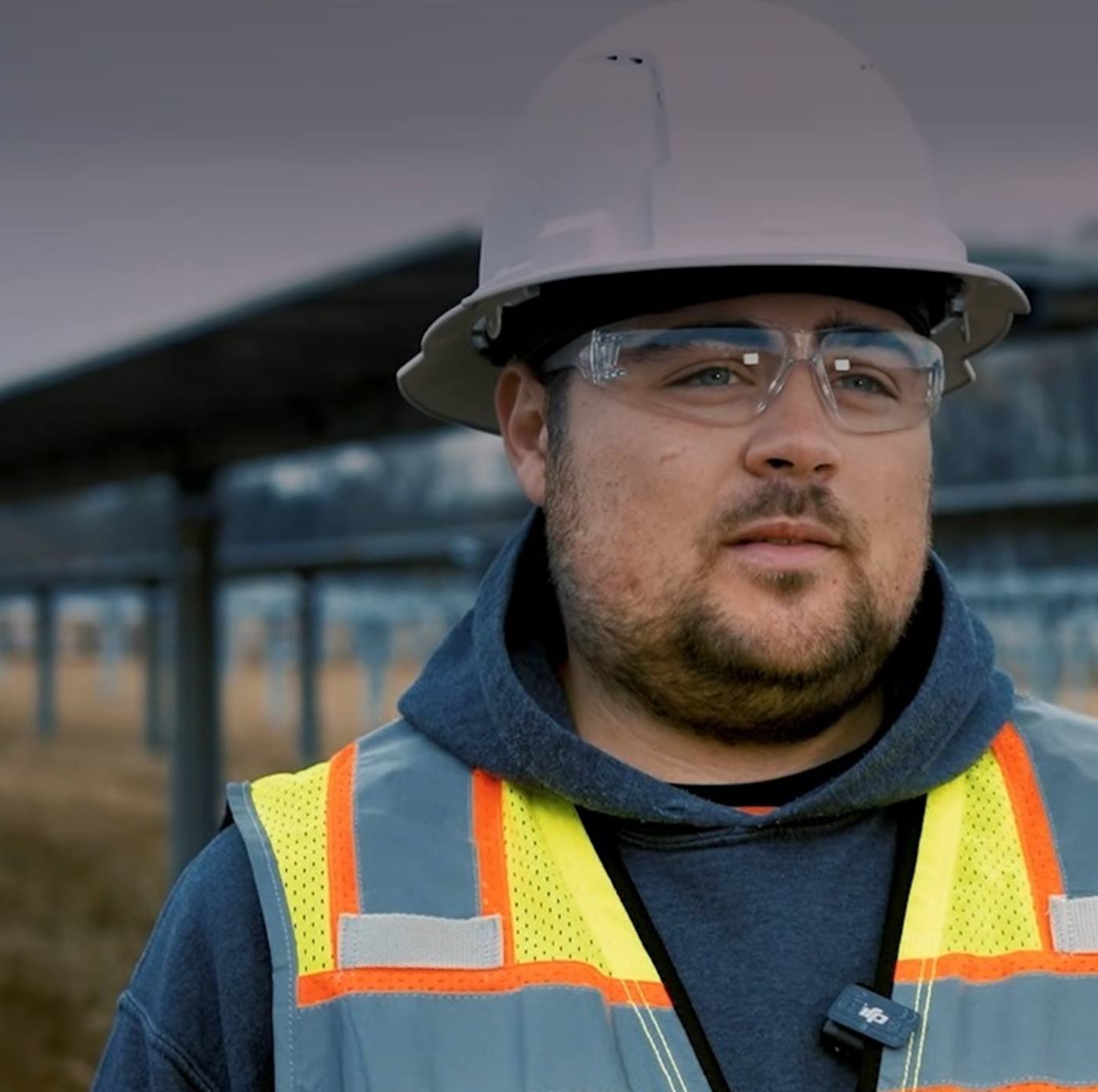
Philipp Kauls, Project Manager at Sunstall
There is still a widespread belief that automation ends at the factory floor. Projects like this show that robust robotics can deliver real value outside traditional industrial environments. Was there a specific moment when it became clear that things couldn’t continue as before?
Philipp Kauls: “Yes. When teams work for weeks in extreme heat or cold – in rain, snow or intense sunlight – you clearly see how close people get to their physical limits. At that point, it became obvious: if we want to maintain quality and speed over time, we need to remove the most physically demanding steps from the process.”
What has changed concretely for your teams?
Philipp Kauls: “The biggest difference is that our installers are no longer limited by fatigue. The robot takes over the lifting and placing of the modules. People focus on alignment, fastening and quality. That makes the workday more sustainable – and the results far more consistent.”
IT Modernization as the Foundation for AI Readiness: How organizations can create the prerequisites for AI initiatives and a future-ready data landscape.