La versione del browser Internet Explorer in uso non è aggiornata. Per una rappresentazione ottimale vi consigliamo un aggiornamento del browser
MAKO Italia: Redefining End-of-Line Automation Through Flexible Robotics in Partnership with KUKA
MAKO Italia designs and manufactures end-of-line and material handling solutions for highly demanding industries such as food & beverage, glass and bagged products. As market requirements move towards greater flexibility, multi-format production and reduced downtime, MAKO has embraced robotics as a strategic enabler. This case history tells the story of a custom robotic palletizing solution developed by MAKO in collaboration with KUKA, combining patented engineering concepts with industrial robotics to deliver flexible, future-proof automation for complex packaging formats.
MAKO: engineering-driven growth in end-of-line automation
Founded in 2016, MAKO is headquartered in Fontevivo (Parma), Italy, and specializes in end-of-line automation and material handling solutions.
After an initial phase of limited investment, the company began a structured growth path between 2022 and 2023, focusing on engineering, proprietary technologies and the development of its own machines.
“MAKO was created with a clear ambition: moving from third-party activities to the development of our own solutions, built around real production needs,” explainsLuca Abretti, Sales Manager at MAKO.
Today MAKO employs around 30 people, covering sales, mechanical, electrical and software engineering, purchasing and production coordination.
This lean structure is reinforced by the close connection with FM Technology, a company founded in 2006 and fully owned by the same founder. FM Technology operates as a service company for mechanical and electrical installations and employs around 150 people.
This allows MAKO to rely on a large pool of skilled technicians for assembly, installation and service, while keeping its focus on engineering and system design.
This setup gives MAKO the flexibility of a small company combined with the execution capacity of a much larger industrial organization.
Serving global markets with flexible end-of-line automation
MAKO operates internationally, with a strong focus on Europe and active projects in Eastern Europe, Central Asia, North Africa and the Middle East, alongside early developments in markets such as Mexico.
Its core sectors include food & beverage, glass container manufacturing and bagged products, where MAKO designs complete end-of-line solutions covering depalletizing, conveying, case handling and palletizing.
“Our real strength lies in flexibility,” says Luca Abretti.
“We work on medium to large products and complex formats, where traditional machines reach their limits. This allows us to design tailored solutions for customers facing frequent format changes or unstable products.”
From the outset, MAKO positioned itself as an engineering partner capable of developing ad-hoc and patented solutions for applications that are still often handled manually due to technical complexity—laying the foundation for a growing role of robotics in its portfolio.
Market trends and the role of robotics
Across the industries MAKO serves, end-of-line operations are undergoing a profound transformation.
Customers are facing increasing product variety, shorter product life cycles and growing uncertainty about future formats.
What was once a stable production scenario is now shaped by frequent changes driven by marketing strategies, packaging differentiation and market volatility.
“In many projects today, customers don’t really know what they will be producing five or ten years from now,” explains Luca Abretti.
“They might start with a limited number of formats, but experience shows that this number can increase rapidly over time. This creates a real risk of investing in machines that become obsolete too soon.”
In the past, automating these processes often meant high costs or rigid solutions that lacked adaptability.
Today, the market increasingly demands systems capable of managing multiple products, formats and even different lines with a single installation.
According to MAKO, this is where robotics becomes a strategic tool rather than a technical choice.
“We don’t see robotics as the best solution in every situation,” says Luca Abretti.
“If a machine has to perform a single, repetitive task forever, a traditional system can still be faster and more cost-effective. But whenever flexibility, prototyping or future adaptation are required, robotics clearly offers a decisive advantage.”
The ability to modify gripping systems, layouts or logic without replacing entire machines allows customers to adapt to new market requirements while keeping downtime and investment under control.
In many cases, robotic solutions also make it possible to consolidate several manual or semi-automated lines into a single flexible system, improving both economic sustainability and operational efficiency.
For MAKO, robotics fits naturally into its engineering-driven approach: not as a standard product, but as an enabler of tailored, future-ready solutions designed to evolve together with the customer’s production.
From market needs to a robotics-driven palletizing solution
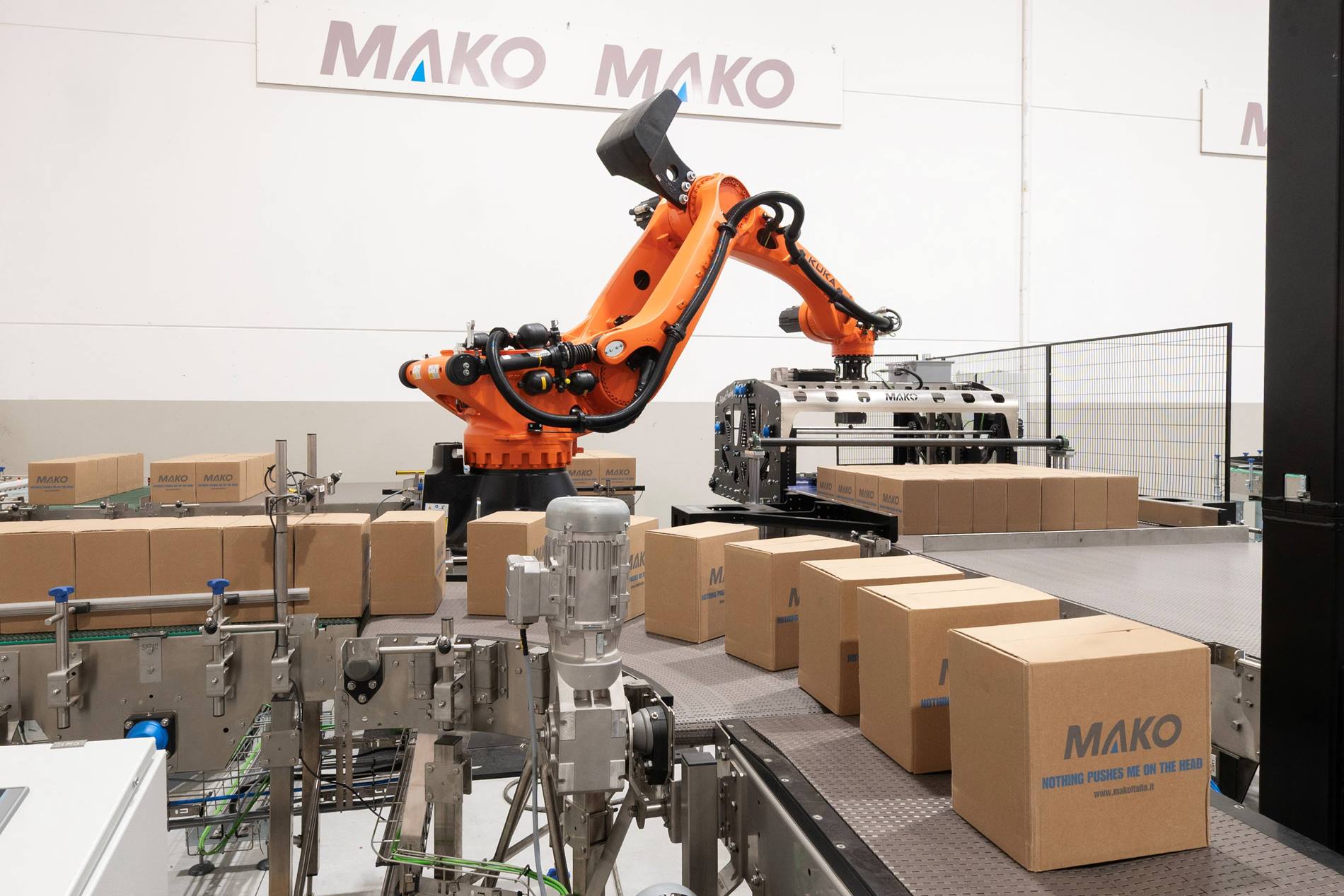
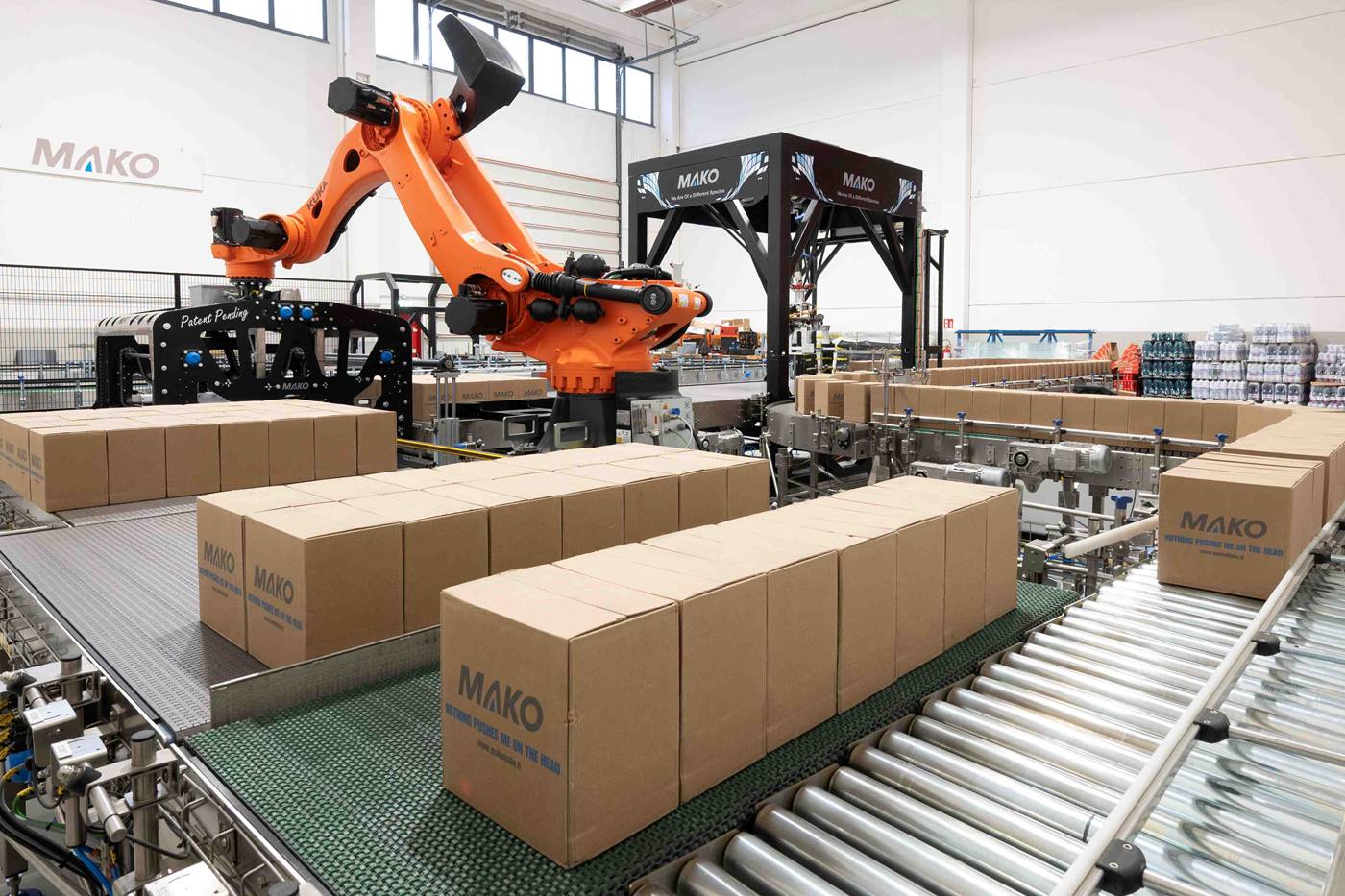
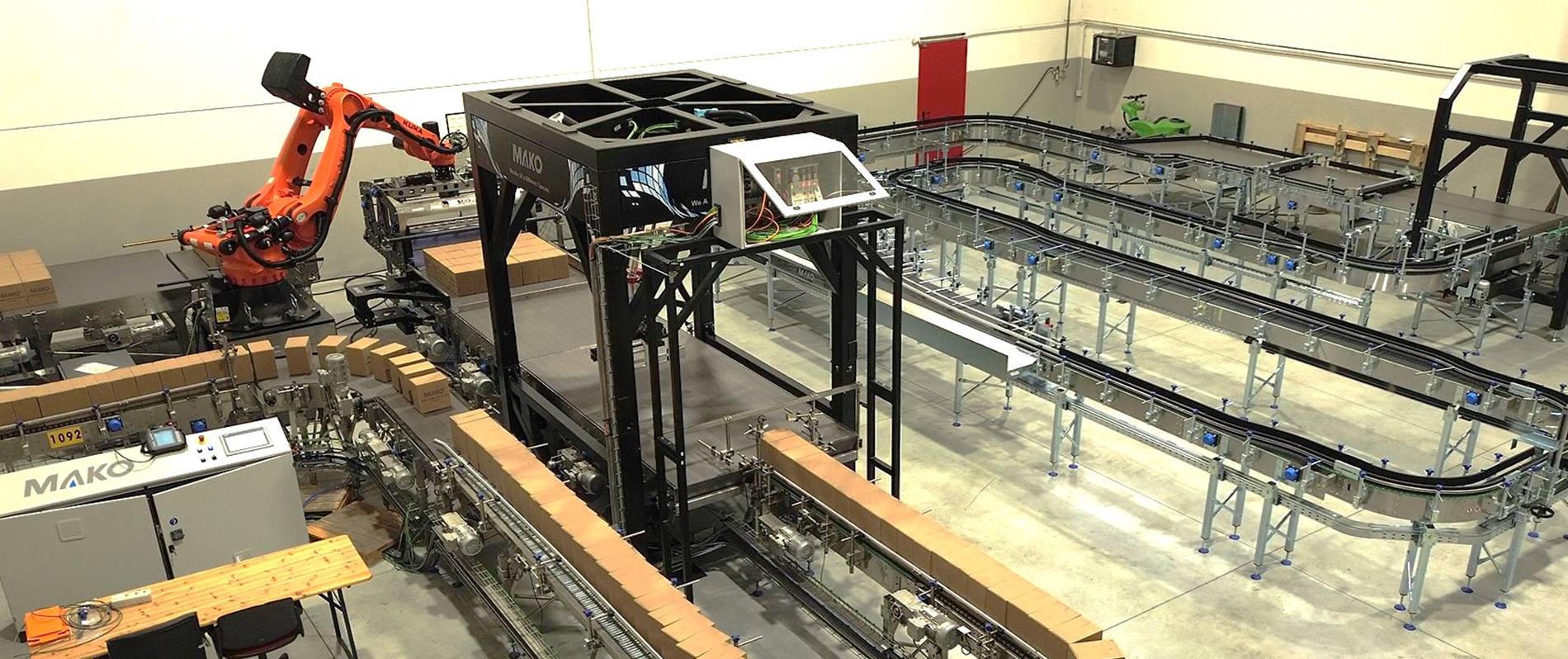
Starting from these needs, MAKO designed a robotic palletizing application conceived to handle variability as a core requirement.
Cartons are accumulated on conveyors and fed according to software recipes defining grouping, orientation and layer patterns.
A Delta robot manages the positioning of each carton, adjusting movement and rotation to form the required layer.
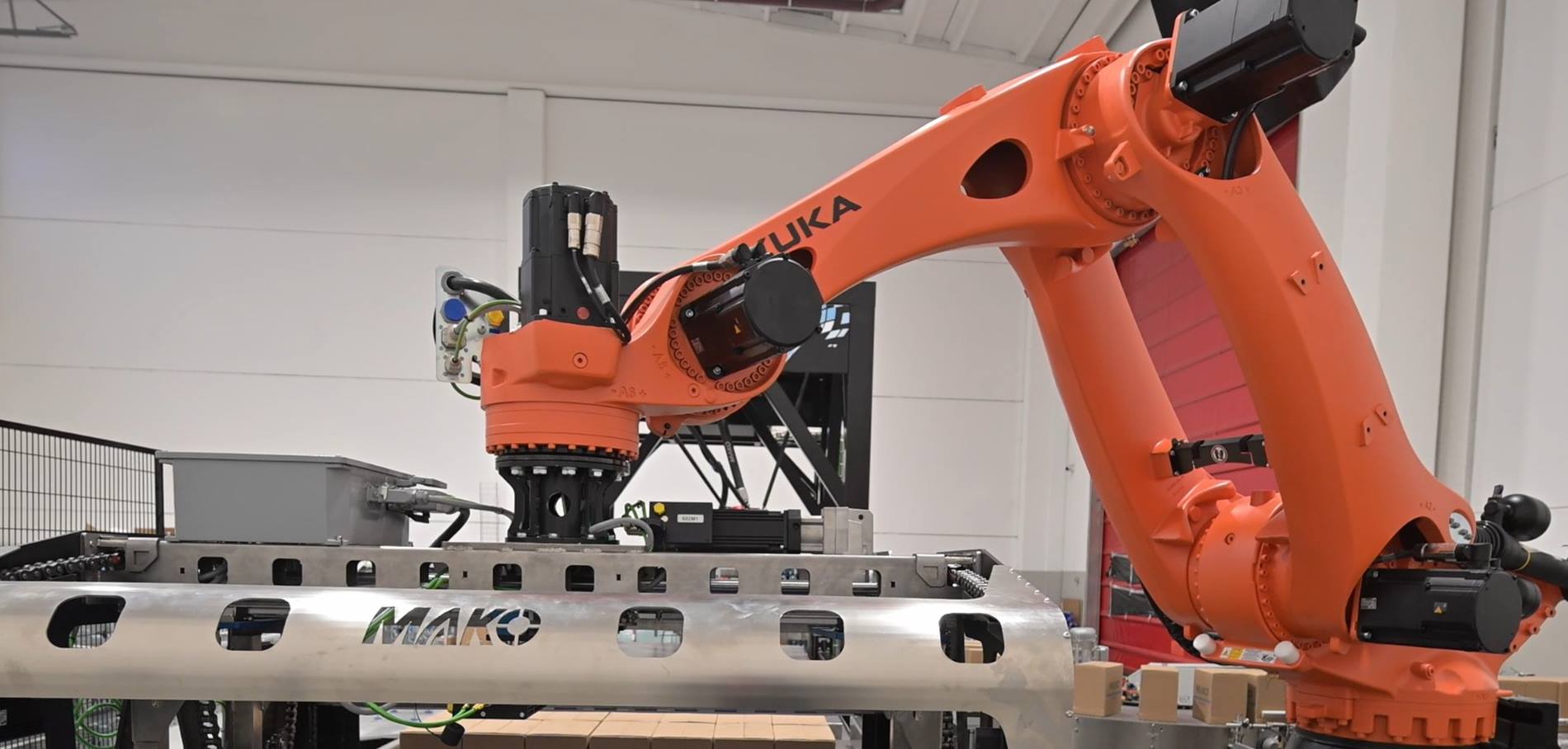
A key element of the solution is the adaptive gripping system developed by MAKO: instead of fixed-size grippers, the company designed an adjustable gripper that extends or retracts depending on the number and size of cartons handled.
“This allows us to pick different group sizes without forcing compromises,” says Luca Abretti. “Keeping cartons closer together means lower conveyor speeds, shorter robot movements and better overall efficiency.”
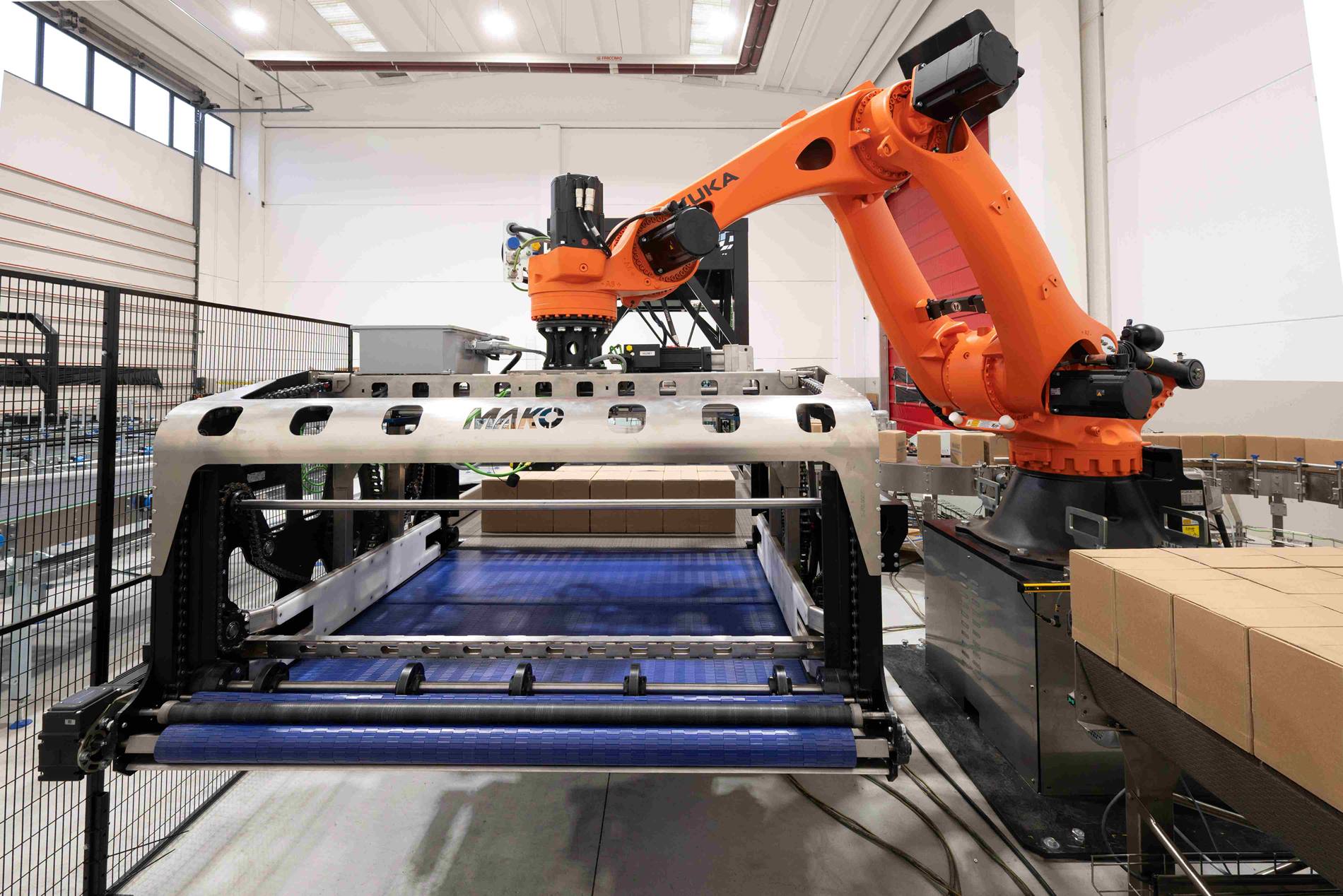
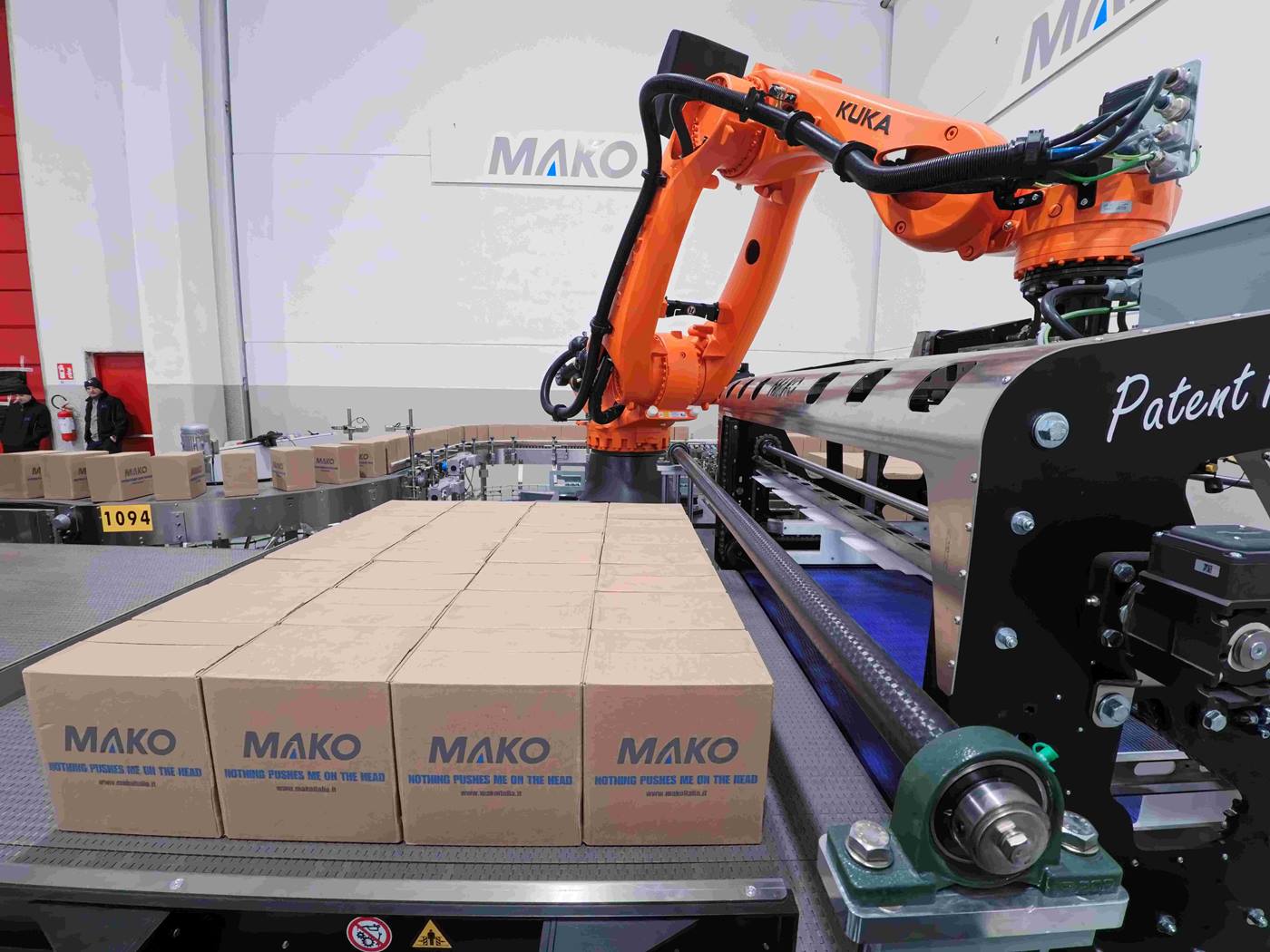
Once the layer is formed, it is compacted and transferred to MAKO’s patented palletizing head, specifically engineered to manage fragile or unstable products.
The head integrates conveyor belts inside the palletizing unit, replacing traditional pushers and roller-based transfers with a continuous belt-to-belt motion. This guarantees consistent handling conditions from the infeed conveyor to the pallet and reduces the risk of layer deformation.
During deposition, belt motion can be actively controlled to compact cartons inward or stabilize the external geometry of the layer, depending on the product. “The goal is simple,” concludes Luca Abretti.
“To give customers a palletizing system that adapts to their products—today and tomorrow—without mechanical rework. That’s where robotics really makes the difference.”
Measurable benefits for end-of-line operations
The robotic application developed by MAKO delivers tangible benefits in terms of productivity, operational continuity and investment protection—especially in scenarios where traditional palletizing solutions reach their limits. One of the most relevant gains is linked to layer preparation and handling efficiency.
Thanks to the adaptive gripping system and optimized carton spacing, MAKO estimates an average productivity improvement of around 30% compared to conventional solutions with fixed grippers, particularly in complex palletizing patterns.
As Luca Abretti explains: “Keeping cartons closer together allows us to reduce conveyor speed and shorten robot movements. This has a direct impact on cycle times, especially on articulated and complex layer layouts.”
Changeover time is another critical parameter. Whereas traditional palletizing machines often require mechanical modifications or tool changes, MAKO’s solution relies entirely on software recipes.
Format changes can therefore be performed without mechanical intervention, significantly reducing downtime.
In practical terms, adapting the system to new products may take minutes instead of hours or days, while major future modifications can often be handled by changing grippers rather than replacing the entire machine. “If a customer changes product formats in the future,” notes Luca Abretti, “with a robotic system you change the head. With a traditional machine, you often need to replace the whole system.”
From an investment and operational standpoint, the solution also allows line consolidation, especially in plants running multiple low- to medium-volume lines. In several cases, a single robotic palletizer can replace two separate machines, reducing overall equipment footprint and simplifying layout design.
This results not only in lower capital expenditure at plant level but also in reduced maintenance complexity.
Robotic systems concentrate wear and maintenance on fewer, well-known components and can rely on standardized service models, further contributing to lower total cost of ownership over time.
Smart Automation for the Beverage Industry with Mako | Schneider Electric Italy
Why KUKA: a partnership built on trust and engineering alignment
For MAKO, choosing KUKA was not primarily about robot specifications, but about finding a partner willing to invest in a shared growth path.
At a time when MAKO was still consolidating its position on the market, KUKA recognized the technical value and innovation potential behind MAKO’s approach, supporting the development of advanced robotic solutions from the very beginning.
“What really made the difference was finding a partner who believed in our ideas and in the people behind them,” explains Luca Abretti. “We didn’t need someone just selling hardware, but a company willing to work with us, support us during development and grow together over time.”
Beyond the commercial relationship, KUKA provided a reliable technological foundation for MAKO’s robotic applications.
The combination of robust industrial robots, structured programming environments and global service availability allows MAKO to fully own its software and application logic while ensuring long-term reliability for end customers.
For MAKO, this balance between independence and support is essential: the robot becomes an integrated part of the system, not a black box.
This alignment in vision and engineering culture laid the groundwork for a collaboration focused on real applications, where robotics is not an end in itself but an enabling technology—supporting MAKO’s goal of delivering scalable, adaptable and future-ready end-of-line solutions.