La versione del browser Internet Explorer in uso non è aggiornata. Per una rappresentazione ottimale vi consigliamo un aggiornamento del browser
TOSA transforms pallet load stabilization: KUKA AMRs as rotating platforms for end-of-line packaging
TOSA Group, founded in 1974 in Santo Stefano Belbo (CN) Italy, is a family-owned company specializing in end-of-line packaging solutions for pallet stabilization and handling. In this case study, TOSA explores the use of KUKA AMRs to enhance flexibility in pallet wrapping and strapping processes.
TOSA Group: evolution, expertise and sector coverage
Founded in Cossano Belbo, Italy, TOSA Group is a family-owned company and one of the leading international players in end-of-line packaging, specializing in tertiary packaging solutions for pallet stabilization.
Over the years, the company has evolved from early mechanical systems to a complete portfolio including automatic wrapping, strapping and shrink-wrapping machines, strengthened by the acquisition of complementary technologies and continuous product development.
Today, TOSA operates across multiple industries — from beverage and chemicals to building materials and logistics — leveraging a highly customized, application-driven approach.
“We are an Italian family-owned company among the leaders in the international end-of-line packaging market, with a strong focus on tertiary packaging solutions,” explains Marco Cocino, Sales and Marketing Manager at TOSA Group.
“What differentiates us is our ability to design tailor-made systems based on specific customer requirements, thanks to a close collaboration between sales and R&D.”
This flexibility allows TOSA to address a wide range of production and intralogistics scenarios, adapting its technologies to different sectors and evolving market needs.
Why TOSA is investing in AMRs for end-of-line applications
The adoption of autonomous mobile robots at TOSA is driven by a clear market evolution and by direct customer demand, particularly in the logistics and intralogistics sector.
In recent years, companies have increasingly required more flexible, space-efficient solutions capable of adapting to changing production layouts and operational needs.
"All our R&D projects originate from customer needs,” explains Marco Cocino.
“We are seeing a strong evolution in logistics and intralogistics, and this is an area where we are increasingly investing.”
In this context, AMRs represent a natural extension of TOSA’s development philosophy: compact, flexible systems designed to reduce footprint while maintaining high performance. Compared to traditional conveyor-based solutions, mobile robotics enables greater adaptability and supports more dynamic end-of-line configurations.
The shift toward AMR technology also reflects the need to overcome the limitations of fixed transport systems, particularly in applications where layout changes and production variability are frequent.
“Using AMRs instead of fixed conveyors allows much greater flexibility in handling palletized loads and significantly reduces occupied space,” adds Marco Cocino.
From a technical perspective, this approach enables more responsive and reconfigurable production environments, as highlighted by TOSA’s R&D department. AMRs can move dynamically between different stations — such as wrapping, strapping or palletizing — allowing faster adjustments and improving the responsiveness of the overall system.
This translates into more efficient use of space, smoother process flows and the ability to adapt quickly to new operational requirements.
Application performance and layout benefits
The introduction of AMRs in TOSA’s end-of-line solution delivers tangible benefits in terms of layout flexibility and space optimization, even if performance indicators vary depending on the specific application.
By replacing traditional conveyor systems, the solution reduces the overall footprint of the line while improving process continuity and adaptability. “We can estimate a reduction of at least 4 to 5 meters in line length compared to traditional infeed and outfeed conveyors,” explains Marco Cocino.
At the same time, the removal of fixed transport systems enables a less rigid layout, minimizing process interruptions and allowing a more efficient organization of intralogistics spaces.
A mobile process: combining wrapping and strapping
At the core of the application is the innovative use of the AMR not only as a transport system, but as an active component of the process.
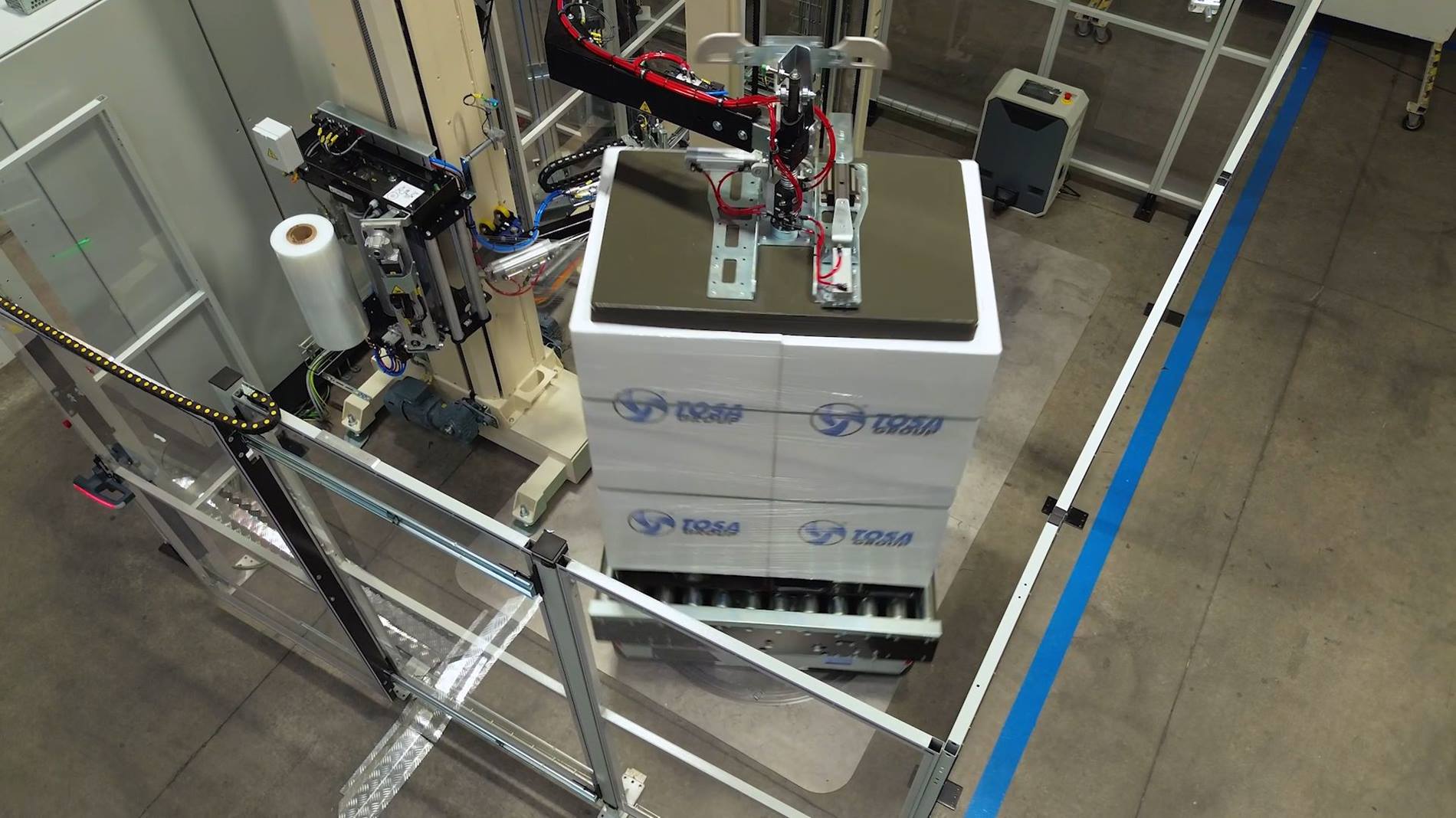
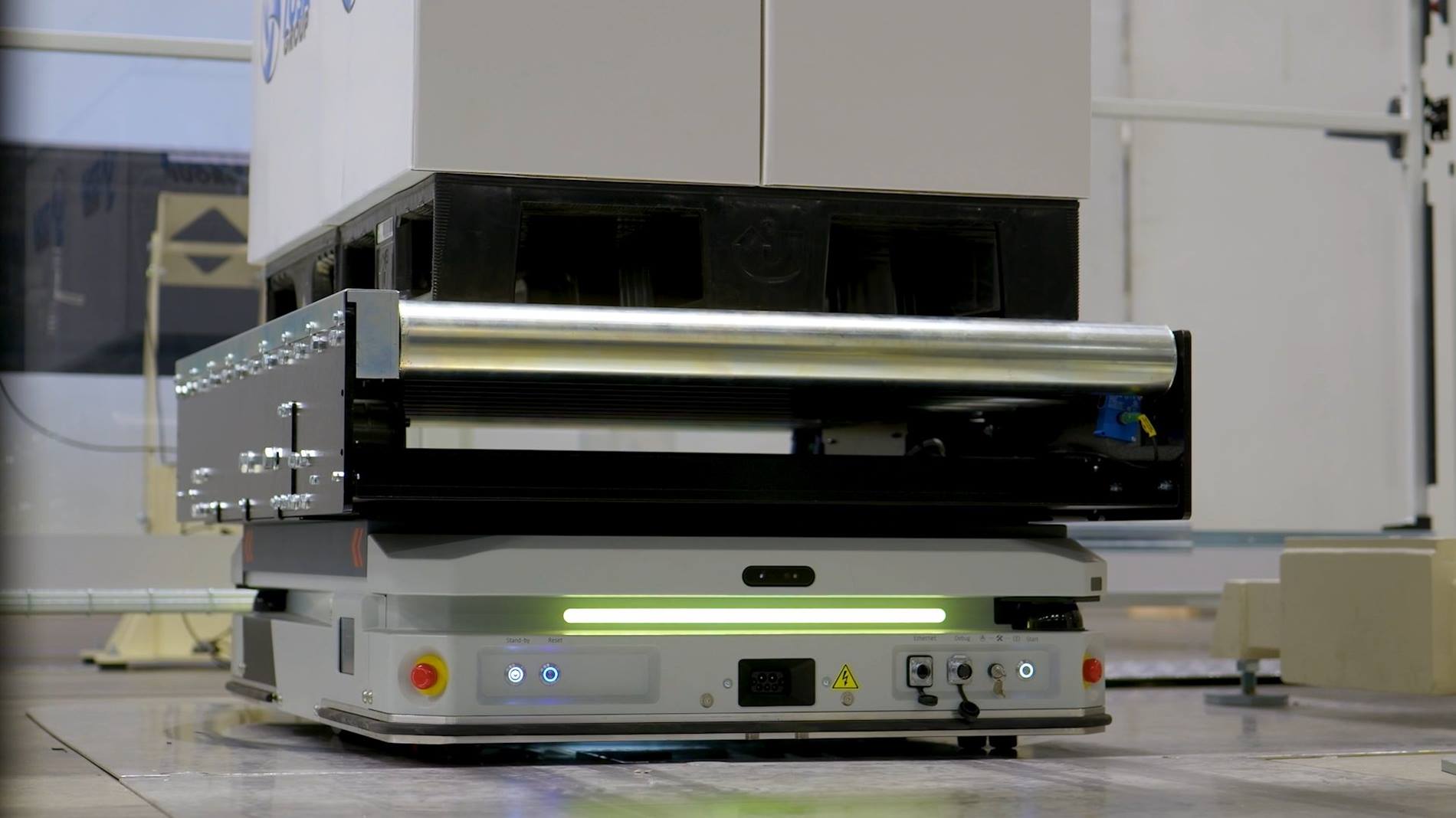
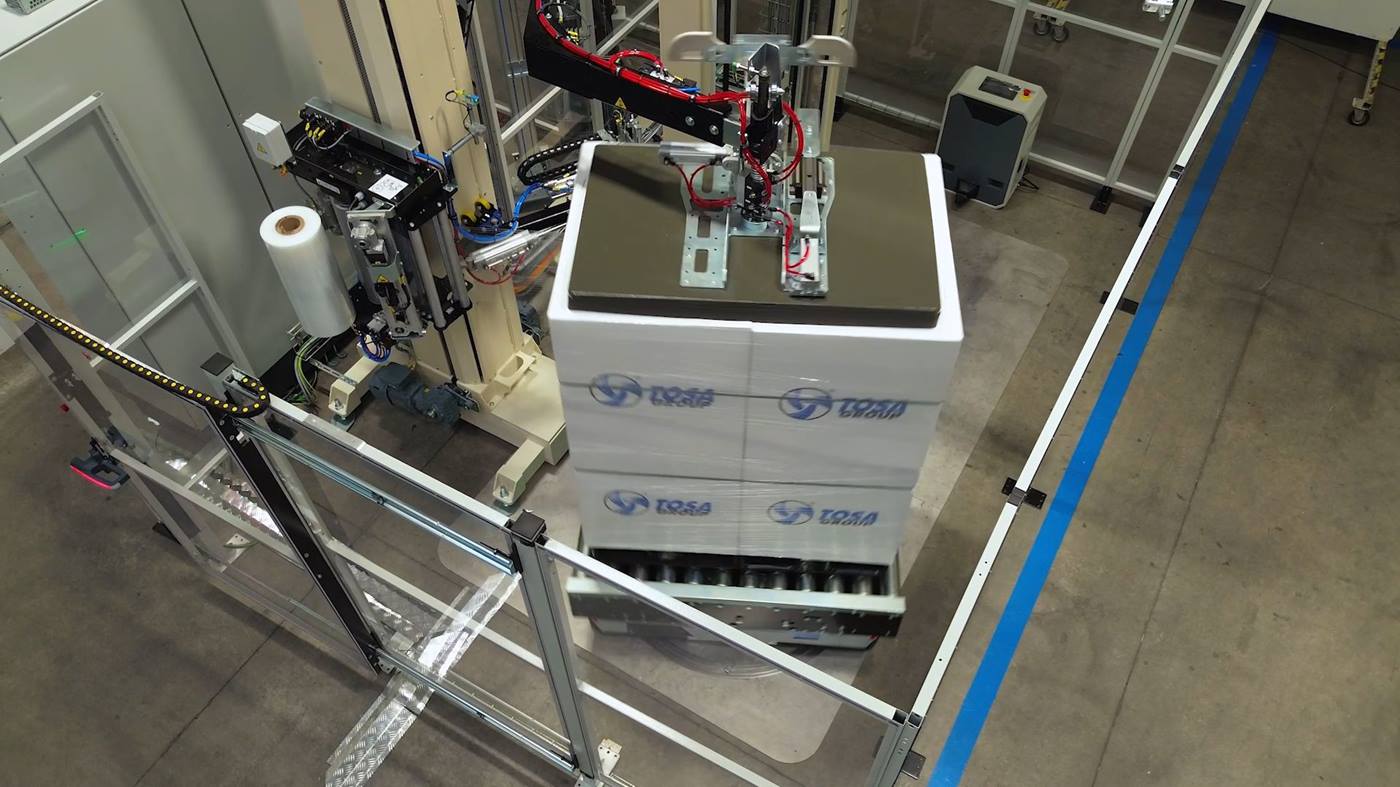
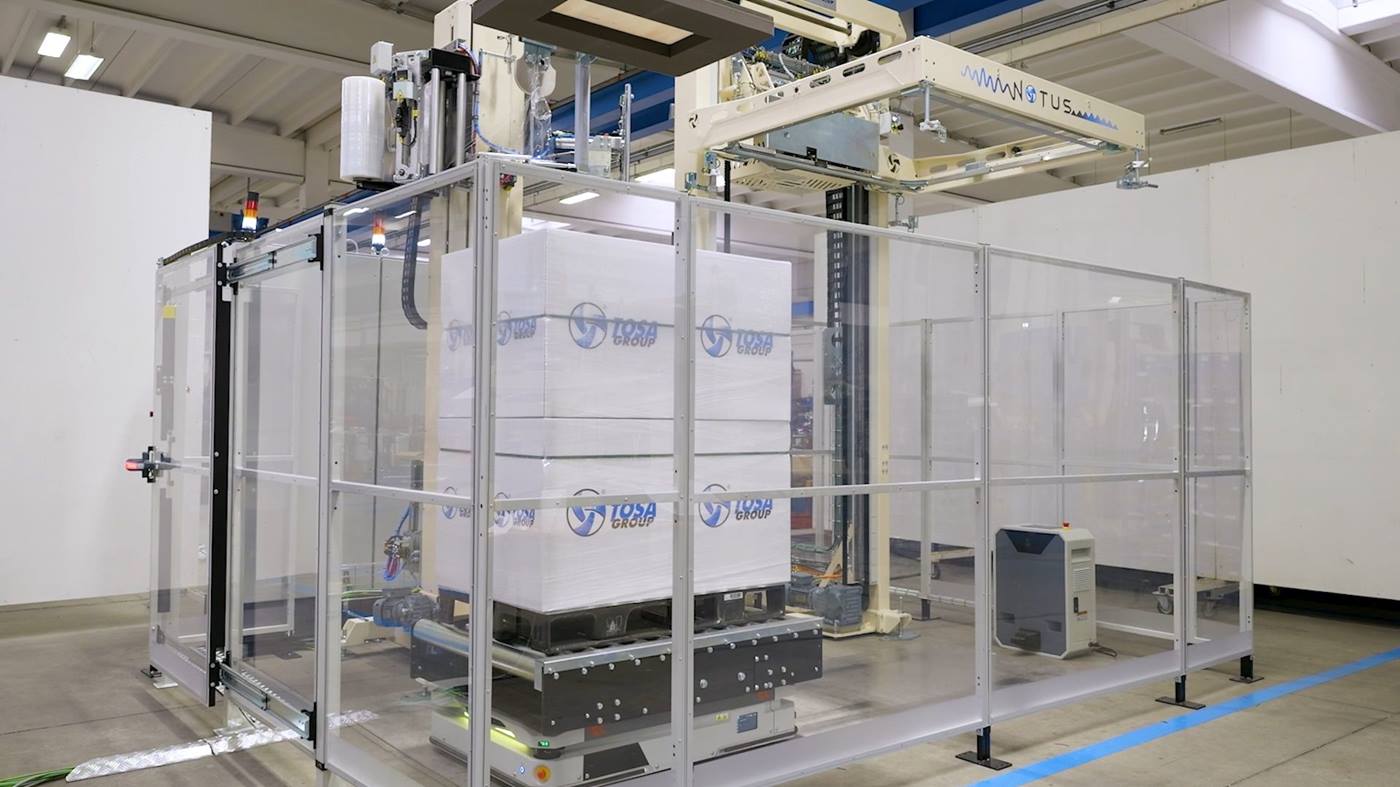
The robot operates as a rotating platform beneath the wrapping machine, enabling the complete wrapping cycle directly on the mobile unit. “The most distinctive aspect of this solution is that the AMR is used as a rotating platform for pallet wrapping, operating at speeds of up to 18–20 rotations per minute,” says Marco Cocino.
Once the wrapping phase is completed — including film cutting, sealing, and load stabilization — the AMR moves autonomously to the strapping station, where the pallet is secured according to the required configuration. With this configuration, the system can achieve outputs of over 40 pallets per hour, depending on process parameters. “This allows us to combine flexibility in material handling with a complete end-of-line process, from wrapping to strapping,” Marco Cocino concludes.
A partnership built on innovation and continuous development
The decision to adopt AMR technology reflects TOSA’s ambition to explore the most advanced solutions available on the market, particularly in scenarios where flexibility and adaptability are key requirements.
Unlike traditional AGV systems, which often rely on fixed guidance structures, AMRs enable autonomous navigation and allow the system to operate without predefined pathways.
“The objective was to adopt the most advanced solution available, based on autonomous navigation, in order to remove constraints such as fixed tracks or reference points and ensure maximum flexibility in the working area,” explains Marco Cocino. The collaboration with KUKA builds on an already established relationship and a shared focus on innovation.
After a first successful experience in robotic wrapping applications, TOSA identified mobile robotics as a natural evolution of its portfolio.
While the development of such a novel application required an initial phase of alignment and joint learning — typical of research and development projects — the cooperation led to tangible progress and a validated concept. “As with any new R&D project, the initial phase required adjustments, but we have seen significant improvements and we are satisfied with the support received,” adds Marco Cocino.
This joint development approach continues to evolve, laying the foundation for future applications where mobile robotics can further expand the possibilities of end-of-line packaging.