You are using Internet Explorer and will not be able to use our website properly. Please change to an up-to-date browser for ideal presentation of the website.
The Power of Automation
Sunstall teams up with Cosmic Robotics to deploy robotic automation that eases labor strain and expands the available workforce for large-scale solar projects.
Mobile Robots Transform Utility-Scale Solar Installation
While automation is often associated with industrial manufacturing, automated solutions have found use in many industries. Construction has been slower to adopt automation since most projects are custom designed and the work needs to be done on-site in the field, rather than on a factory floor. However, one contractor in the solar power sector had found the benefits of using robotics to perform formerly backbreaking labor in the field. This has been a major improvement for both the company and its field team.
Sunstall: Building the Physical Infrastructure of Solar Power
Founded in 2011 in Novato, CA, Sunstall is a U.S.-based contractor specializing in the mechanical construction of large-scale, ground-mount solar energy systems all over the United States. The company works together with solar project developers and EPCs to execute on-site installation scopes that include pile driving, racking and tracker assembly, and solar module installation. Sunstall Project Manager Philipp Kauls says the company works with organizations of varying sizes to install the solar projects, from local farmers looking to be more energy independent to large installations run by energy providers. “Our crews are responsible for building the physical structure of the solar plant and installing the modules that ultimately generate power,” explains Kauls.
The system from Cosmic Robotics relies on a KUKA robot to deliver the precision and durability required for outdoor solar field installation.
The Physical Demands of Solar Module Installation
Typically known as a solar panel, photovoltaic modules (PV modules) are composite materials designed to directly convert sunlight into electricity. Industrial solar projects can range in wattage from 1 megawatt to hundreds of megawatts or even gigawatts, which means a single project could require the installation of thousands or even millions of PV modules. The module installation process is very labor intensive. Each module can weigh over 80 pounds, and its large, flat shape makes holding and installing the panel quite uncomfortable.
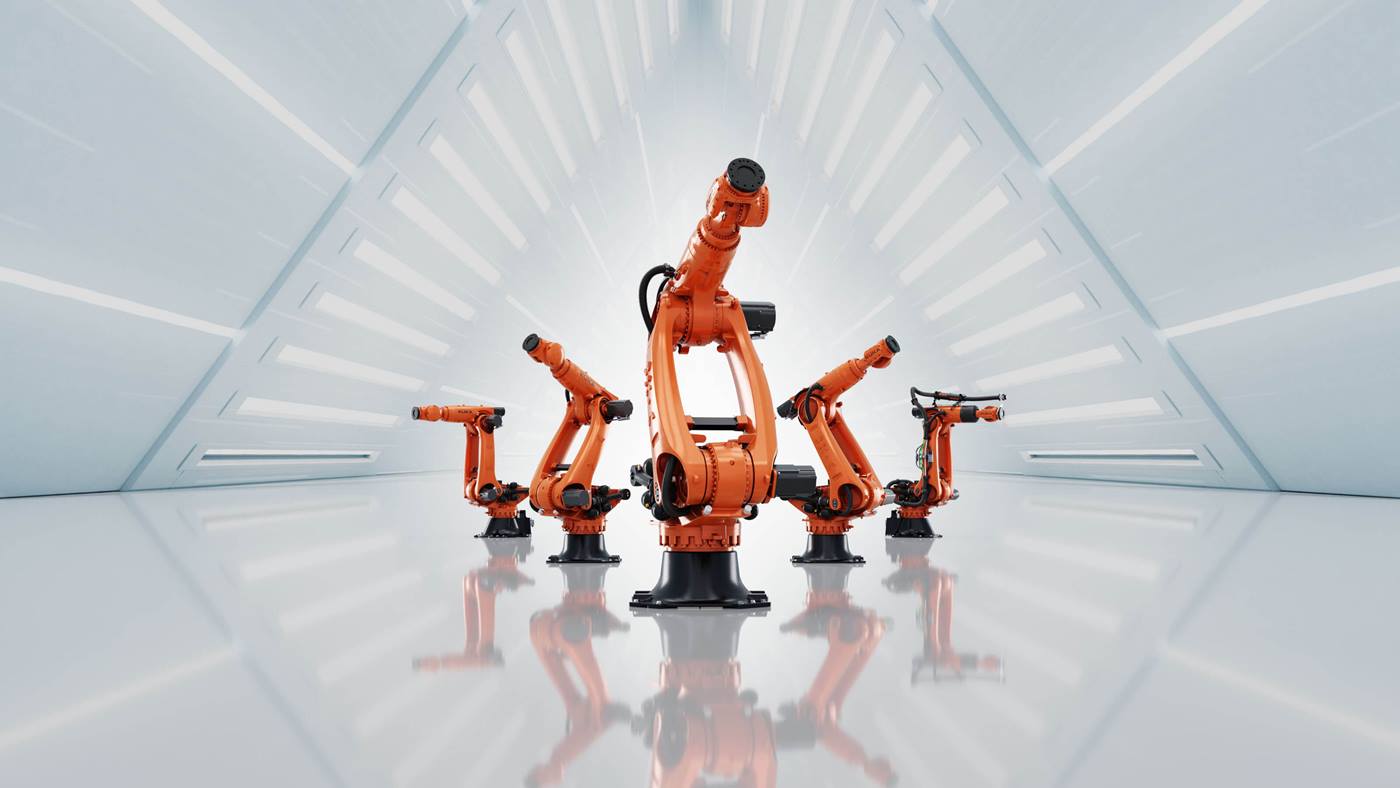
A foundry-rated KR IONTEC robot supports outdoor solar module installation while reducing physical labor strain.
Installation crews typically consist of five or more people to transport, lift, and fasten modules into place. “Typically, two to three people would pick up a module, while others align and secure it in place,” explains Kauls. “It’s demanding work, especially when you repeat the same motion all day,” Kauls says. Over time, this physical strain can affect both productivity and installation consistency, particularly on large projects with high daily output targets.
As utility-scale solar projects grow larger and modules get heavier, KUKA robotics helps installers work more safely and efficiently.
Labor Constraints and the Push Toward Automation
“Depending on the project location, we can work in a variety of weather conditions – ranging from around 105 degrees to below freezing – rain, snow or shine. It’s just hard on people,” Kauls says. As labor availability has become more constrained, Sunstall began looking for ways to improve the sustainability of its installation workflow. “It can be difficult to find people who are willing and able to perform physically demanding work for long periods, while still meeting the quality and productivity requirements of utility-scale projects, over the course of a full year” Kauls explains. These challenges led Sunstall to explore automation as a way to support its crews.
As solar installations scale from thousands to hundreds of thousands of panels, robotics becomes a key enabler of efficient deployment.
Powering up the installation of solar panels
Sunstall partners with Cosmic Robotics to deploy automation that improves the efficiency and consistency of PV module installation.
Cosmic Robotics supports solar field installation in remote outdoor environments across the United States.
Partnering with Cosmic Robotics
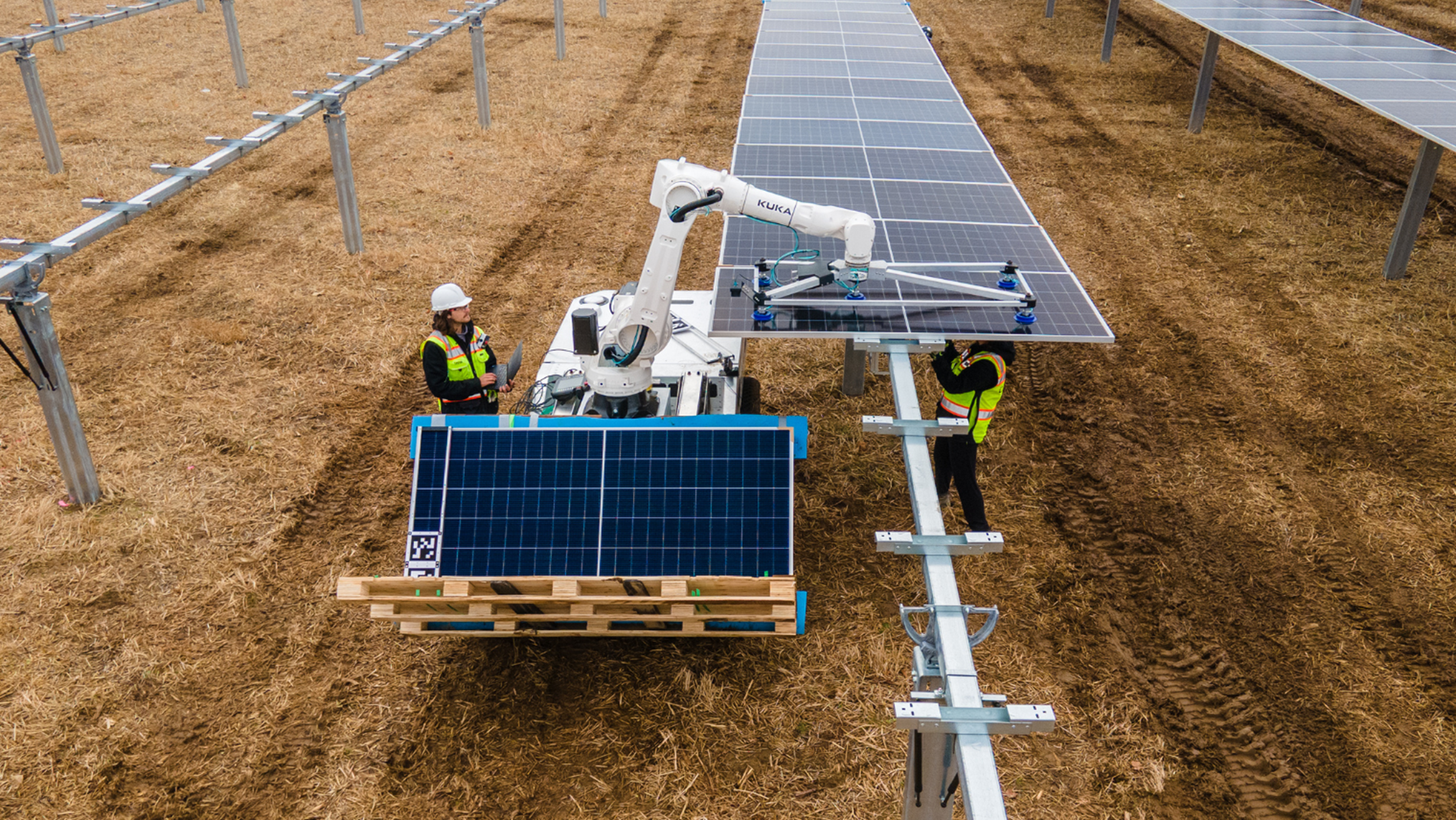
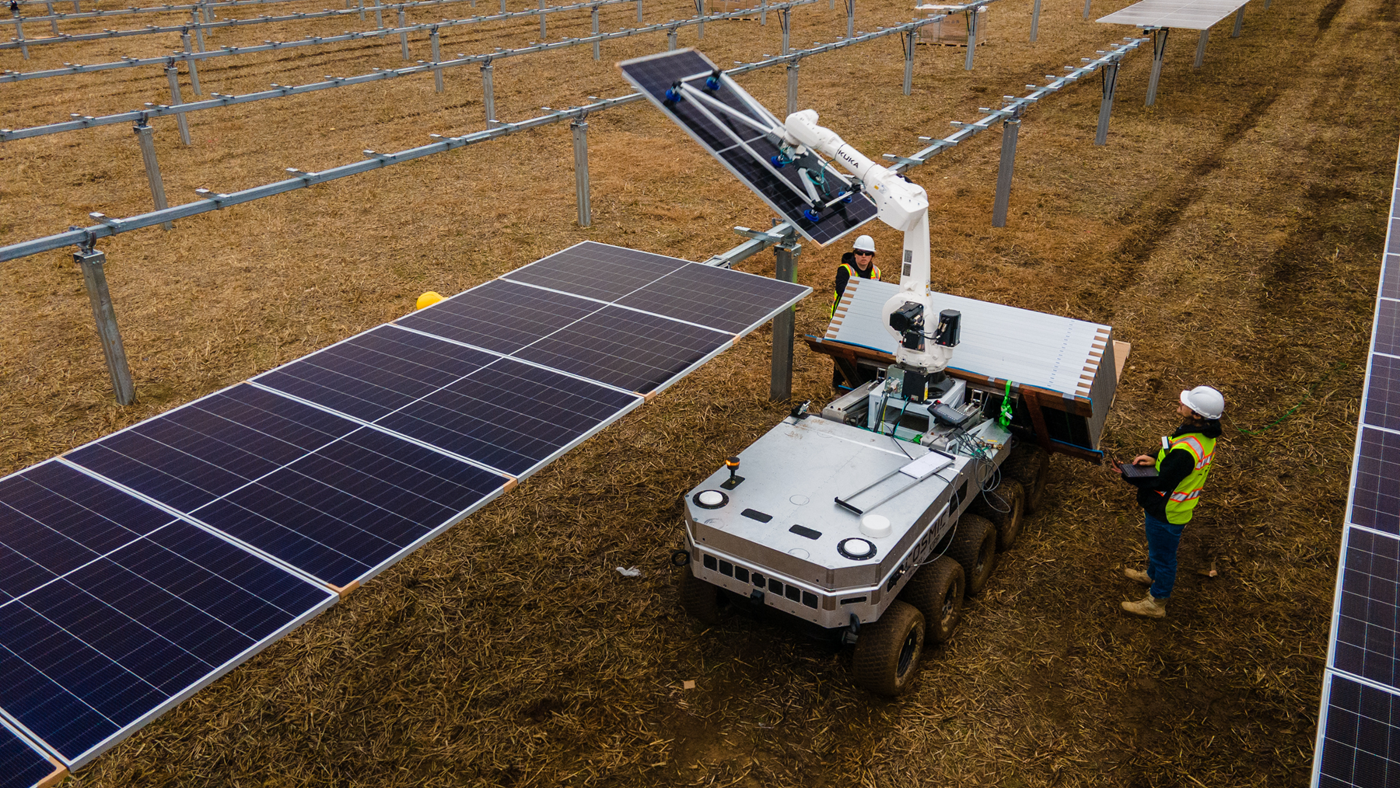
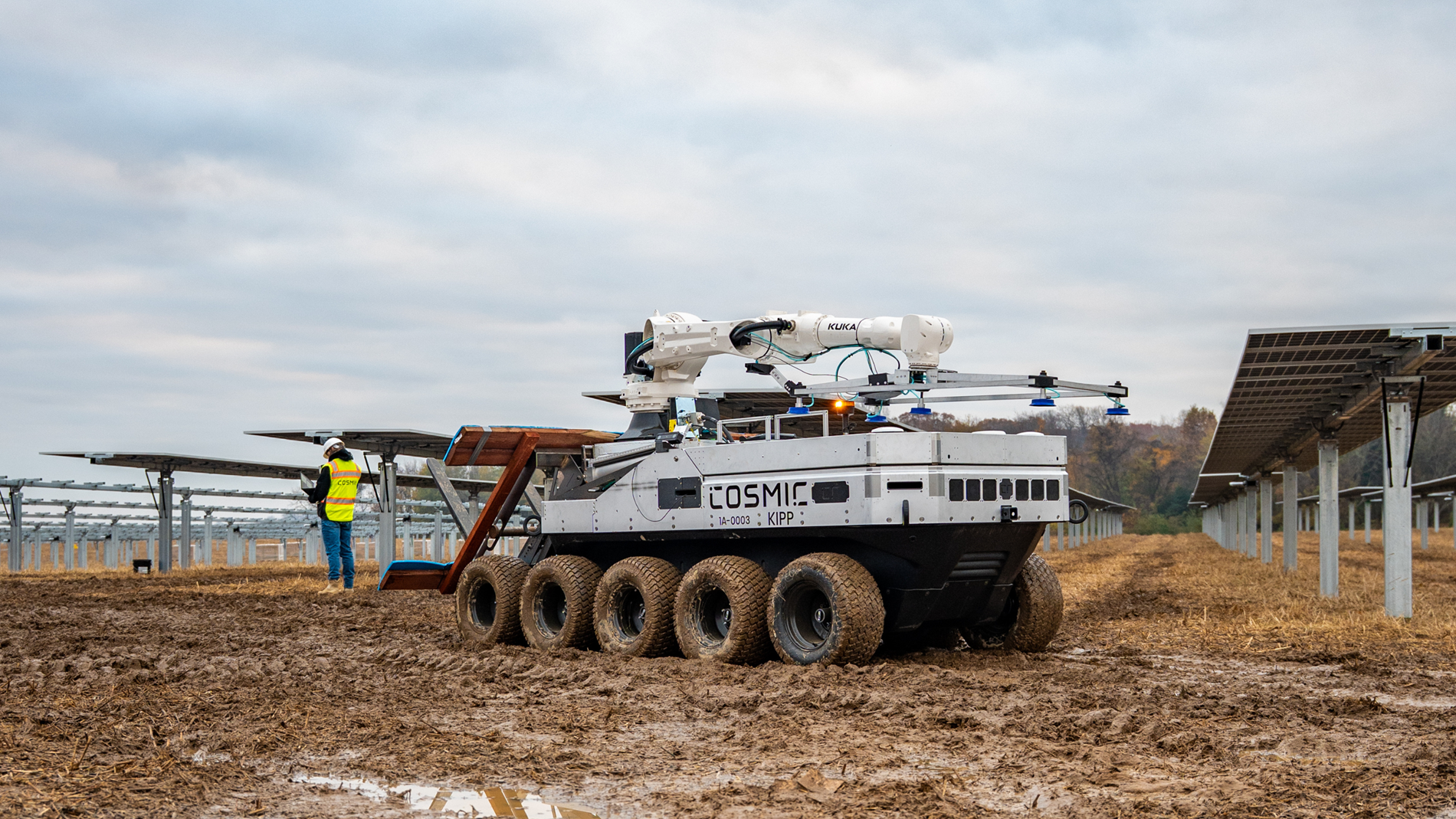
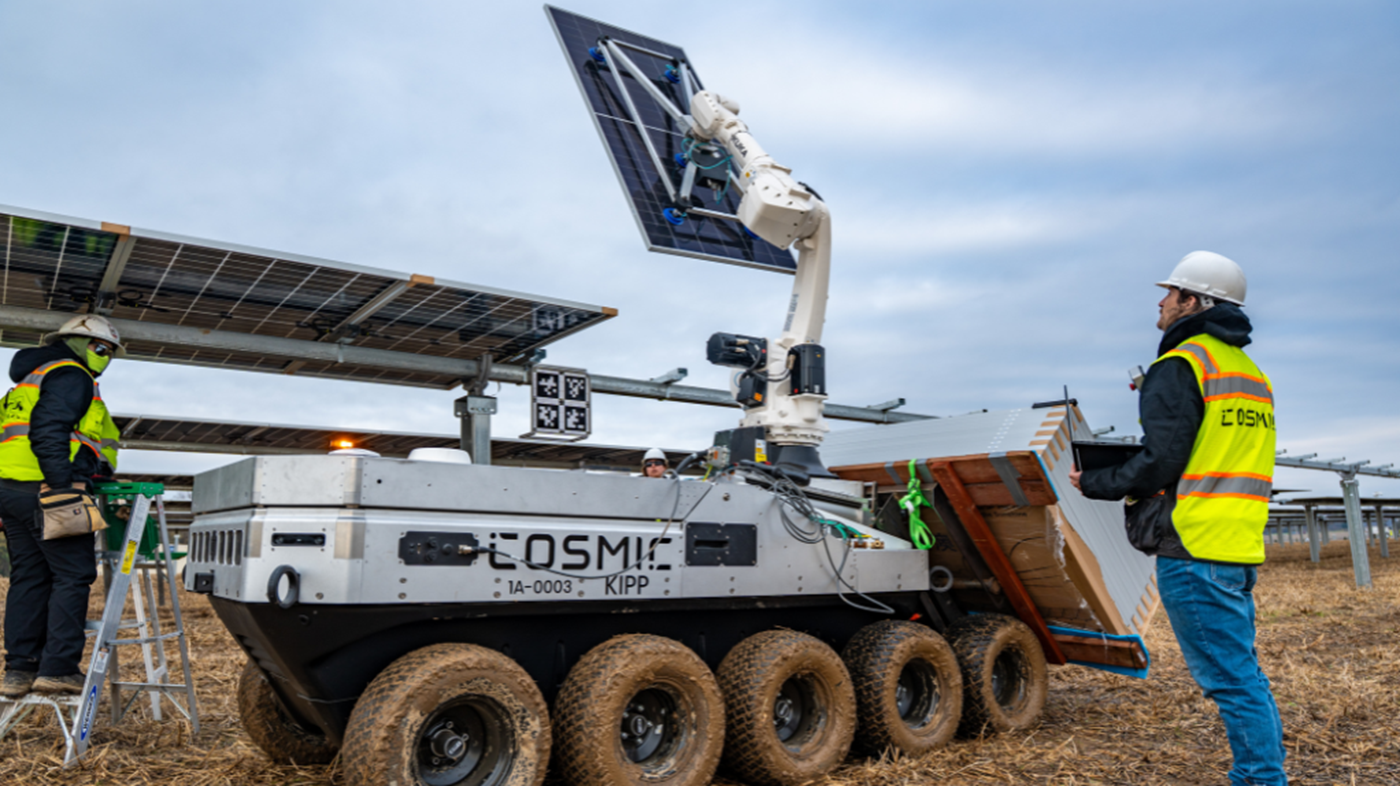
Sunstall eventually partnered with Cosmic Robotics, an AI-robotics company that produces the Cosmic-1A, an autonomous mobile robot designed to be a force multiplier for field construction. The fully electric robot incorporates a rugged all-terrain vehicle platform and a large KUKA robot arm equipped with a specialized end effector for lifting solar panels. “There’s an off-road UGV vehicle base that does the driving,” says James Emerick, CEO of Cosmic Robotics. “On top of it is the KUKA manipulator that uses a computer vision system that we’ve developed in-house to detect the position and orientation of the solar panel, pick it, and place it on the racking.” The robot places the solar panels onto the racking with ±1mm precision.
Robotic installation reduces repetitive heavy lifting while improving placement consistency across long work shifts.
Selecting a Robot Built for Harsh Field Conditions
In looking for a robot supplier to partner with for this system, Cosmic Robotics had numerous features to consider. The system had to be robust enough to contend with varying environments that could include high moisture content, dust and rain. In addition to withstanding the elements, the robot had to be able to handle the 80-pound payload, even with the arm fully extended. Finally, it needed the precision necessary to lift the fragile solar panels and place them on the frames without damaging them. The company landed on the KR IONTEC robot arm as the perfect fit for meeting the precision, endurance and payload requirements of the job. “We went with the Foundry version because we needed the most rugged piece of hardware to be able to withstand the elements,” explains Emerick. “With the Foundry version we get the extended temperature range and positive pressure on the joints to keep out any dust and debris.”
Integrating Robots into the Installation Workflow
Workers set up racking that hold the solar panels, and the robot travels down the row, placing the panels on the frames.
The job still requires a full crew to set up the frames that hold the solar panels, as well as people to fasten the panels to the frames, but therobot eliminates the tiring and physically challenging work of lifting the panels into position. “I don’t care who you are, picking up an 80-pound load over and over for eight hours a day will leave you physically exhausted,” says Kauls. “Having the robot handle that part of the process takes a huge burden off our crews.”
With the heavy lifting removed, the work becomes more sustainable for installers. With the robot performing the lifting and placement tasks, Sunstall’s installers can focus on fastening, alignment, and quality control. “In practice, the robot can place modules faster and more consistently than a fully manual crew,” Kauls explains. “That means our installers are no longer limited by fatigue over the course of the day.”
Improving Throughput and Crew Efficiency
After getting the Cosmic-1A up and running, Sunstall was able to significantly increase installation throughput while improving the overall workflow. “Before, we had a five-person crew handling transport, lifting, and installation,” Kauls notes. “With the robot taking over the lifting and placement, we can work with a smaller crew while maintaining or improving production rates. The efficiencies pay for themselves, and they only stand to improve.”
KUKA robots enable millimeter-accurate placement of heavy solar modules in outdoor environments with changing conditions.
Robotic automation helps address labor challenges in renewable energy by easing physical strain and expanding the available workforce for large-scale solar projects.
Cosmic Robotics plans to use the same KUKA robot platform to develop a fastening solution that enables users to send the robot out with one or two operators while it transports, places and fastens each panel on its own. With the current version of the robot already outpacing human fasteners on site, this has the potential to create an even more efficient solar installation solution.
“This is good for us because we’re overall more productive,” Kauls says. “It’s good for our crews because they have fewer repetitive, straining tasks and allow them to use their skills elsewhere. Once means and methods are fully developed the technology will benefit the industry by reducing manpower for panel installation.”
A major challenge that has hampered the expansion of solar energy has been the time and labor needed to install these systems. With Cosmic Robotics and KUKA as partners, Sunstall is overcoming these limitations, and just in time to meet customer interest. Currently, the company has two more installations planned in Colorado and California, and demand is only growing.