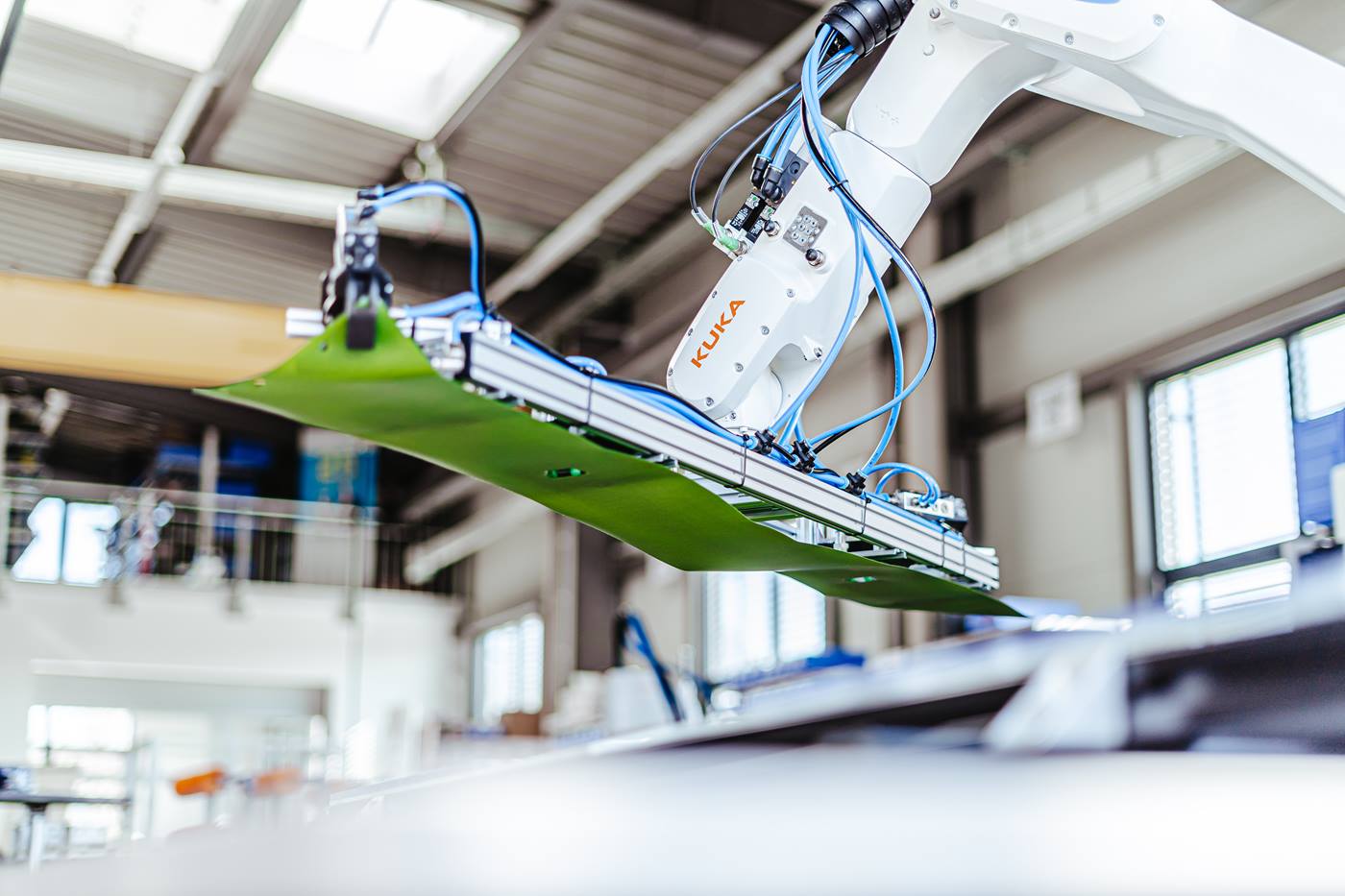
Are your packaging needs changing faster than your production line?
Smaller batch sizes. More frequent product changes. Increasing quality requirements. A shortage of skilled workers. Volatile demand. Many companies face the same challenge:
How can production and packaging processes be automated when products, formats, and workflows are constantly changing? This is precisely where the potential of robot-based automation lies. Modern automation today no longer consists of rigid machines and fixed motion sequences. Intelligent robotics combines motion, sensor technology, vision technology, simulation, intuitive operation, and adaptive control into an integrated production system.
This results in packaging solutions that:
- integrate new products faster
- significantly simplify format changes
- make material flows more flexible
- enable digital planning of production environments
- scale processes
- support both manual and automated processes more efficiently
- and integrate much more easily than many companies expect
The crucial question today is no longer whether packaging automation is possible, but how flexibly it can respond to real production conditions.
Traditional rigid automation is increasingly reaching its limits
That is why we at KUKA Robotik also see ourselves as an adaptive production system:
- mobile material supply
- intelligent image processing
- virtual planning
- simulation-based commissioning
- intuitive operating concepts
In discussions with partners and customers, we identified pain points in packaging tasks and asked KUKA specialists about the solutions that modern robotics offers for these challenges.
How can different products and packaging formats be handled automatically?
Variations in package sizes, product shapes, or quality are often still seen as barriers to automation. However, modern robotics can now respond with significantly greater flexibility. Adaptive production logic, vision technology, and intelligent motion control enable processes that dynamically adapt to new requirements.
Learn more:
- why rigid automation has its limits
- how flexible robotics creates new adaptability
- why adaptive production systems are becoming increasingly important
- how you can use the KUKA Automation Management Platform (KUKA AMP) to integrate continuous learning processes via AI into automation workflows
Oliver Brändle, Industry Segment Manager at Schmalz, and KUKA expert Christina Stark
How can automatic packaging be integrated without significant engineering effort?
Many projects fail not because of the technology—but because of the perceived complexity. Today, integrated robotics solutions combine robotics, vision technology, grippers, and user interfaces into preconfigured systems. This makes automation significantly easier to integrate.
Learn more:
- how integrated robotics reduces engineering effort
- why intuitive operation creates new possibilities
- how plug-and-play concepts simplify integration
André Christian Völkerath, Sales Manager at Mech-Mind Robotics, and KUKA expert Ralf Schneider
How future-proof is an automated packaging line?
Many companies are asking themselves: How flexible and future-proof is the solution? How scalable is production? And how quickly can a return on investment be achieved? That is why robotics is increasingly moving toward modular production architectures.
Learn more:
- why modular robotics reduces risks
- how flexible cell concepts enable new scaling
- why adaptability is becoming a key success factor
Daniel Rubarth, International Business Development Manager at UnchainedRobotics, and KUKA expert Dieter Rothenfußer
How can packaging lines be operated flexibly when product changes are frequent?
Frequent product changes and volatile material flows are posing increasing challenges for traditional production lines. Modern robotics, on the other hand, enables flexible format changes, adaptive production logic, and dynamic material supply – all the way to mobile transport processes using AMRs.
Learn more:
- how flexible robotics reduces mechanical modifications
- why mobile robotics enables new material flow concepts
- why adaptive production logic is becoming crucial
Michael Ruf, Managing Partner at transnova-RUF, and KUKA expert Dieter Rothenfußer
How does packaging automation help address the shortage of skilled workers?
Rising demands and staff shortages are increasing pressure on production and logistics. Modern robotics helps companies stabilize processes, reduce the workload on employees, and make production environments more resilient.
Learn more:
- how intelligent automation increases production stability
- why a holistic view of processes is crucial
- how companies can automate step by step
Markus Bartels, Sales Director at Walterwerk Kiel, and KUKA expert Christina Stark
How can automation projects be planned reliably even as requirements change?
Rarely does an automation project begin with fully defined parameters.
That is why virtual planning and simulation are becoming increasingly important. Digital models help identify risks early on and make adjustments easier to plan.
Learn more:
- how simulation increases planning reliability
- why virtual planning simplifies later changes
- how digital models reduce project risks
Moritz Hamm, Sales Director for Germany, Austria, and Switzerland at Piab Group, and KUKA expert Ralf Schneider
How do you create a future-proof packaging and production architecture?
Production requirements are changing faster than traditional plant designs. Product sizes are shrinking. Speeds are increasing. Material flows are becoming more dynamic. It is essential to view robotics as the heart of a scalable production architecture—and to do so holistically: from production and packaging all the way to AMR-based intralogistics.
Learn more:
- why future-proofing is crucial as early as the planning phase
- how integrated robotics enables new levels of scalability
- why flexible production architectures are becoming increasingly important
Luca Carollo, Marketing & Sales Manager at Clevertech, with Christina Stark, KUKA
Packaging Solutions with KUKA
- Flexible adaptation instead of rigid production logic: New products, formats, or packaging designs can be integrated much more quickly, often without mechanical modifications.
- Integrated robotics reduces complexity: Robotics, vision technology, grippers, operation, and process logic work together as an integrated system.
- Modular production architectures increase scalability: Production environments can be expanded step by step and flexibly adapted.
- Adaptive production logic increases responsiveness: Intelligent robotics and the use of AI enable faster adjustments to changing requirements.
- Simulation reduces project risks: Virtual planning identifies bottlenecks, collisions, and optimization potential early on.
- Mobile robotics enables flexible material flows: AMRs enable adaptive intralogistics without rigid conveyor structures.