You are using Internet Explorer and will not be able to use our website properly. Please change to an up-to-date browser for ideal presentation of the website.
KWM Gutterman Increases Output, Worker Safety with Easier Automation
Turnkey robotic solutions for press brakes, with custom integration, provide a simple solution for increasing output at KWM Gutterman.
A Collaborative Effort in Automating Press Brakes
Millions of people around the world have woken up to learn a harsh lesson in the importance of the humble gutter, often taught in freshly flooded basements or waterlogged ceilings courtesy of a leaf clog. Controlling water flow around a building is a vital part of modern architecture, and construction suppliers must trust their equipment to provide effective gutters customized to fit buildings in every conceivable design. To accomplish this, gutter manufacturers rely on businesses like KWM Gutterman, an OEM that supplies roll-forming equipment for gutter production, often with the assistance of automation to deliver gold-standard gutters.
Karl W. Minor, Sr. was a contractor in the early ‘60s with expertise in roofing, siding and gutters, and gained expertise in repairing roll-forming machines for gutters. A decade later, he founded KWM Gutterman to produce his own line of gutter machines, finding great success. Still owned and run by the Minor family, KWM Gutterman produces its Ironman of gutter machines, in addition to repairing all KWM discontinued lines of gutter machines.
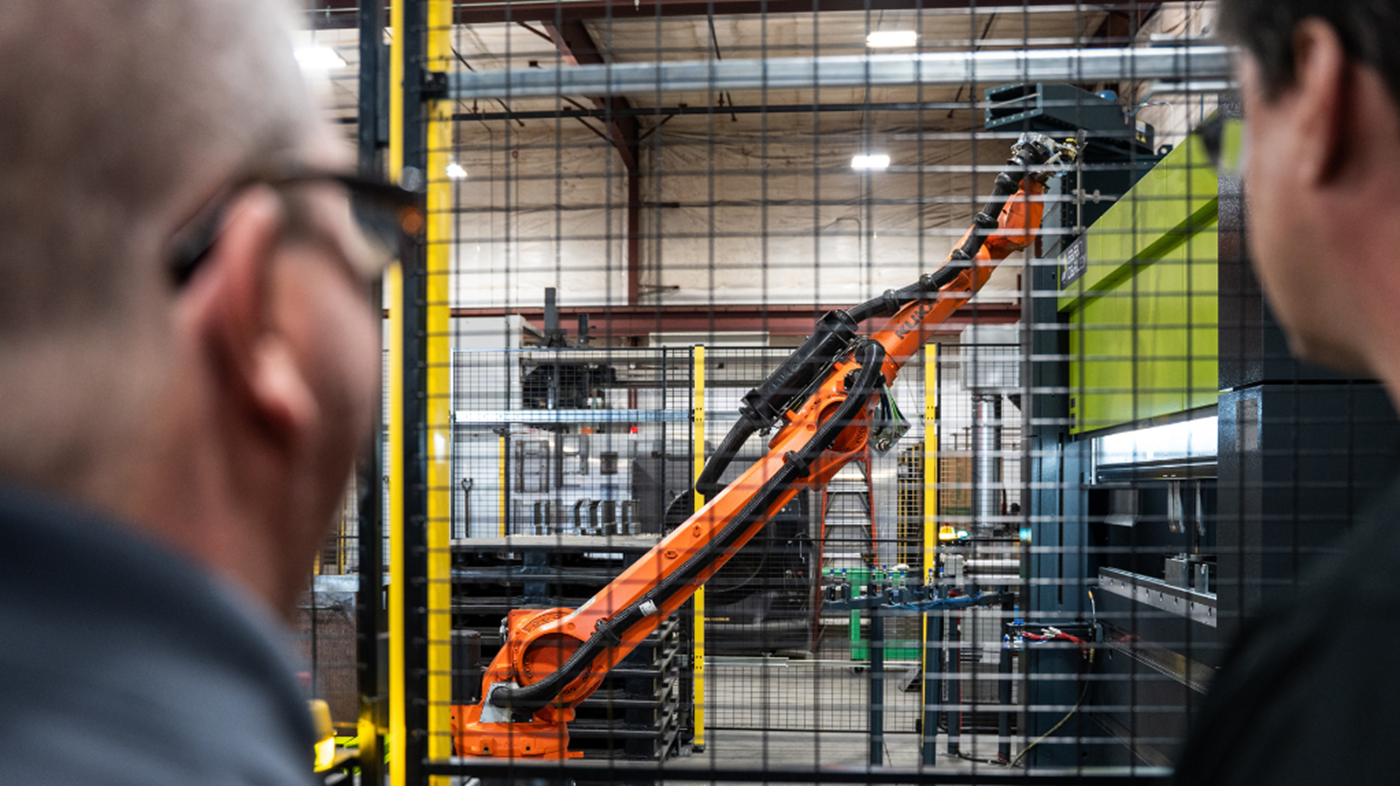
KWM Gutterman, a gutter forming machine OEM, adopted robotic automation to boost press brake output while improving consistency and workflow.
Recently, KWM Gutterman has struggled to fill roles within the company due to the skills gap affecting all areas of modern-day manufacturing. Eventually, the company discovered how to implement automation technologies to keep production at the level needed to meet demand, freeing up its human workers for more skill-intensive tasks.
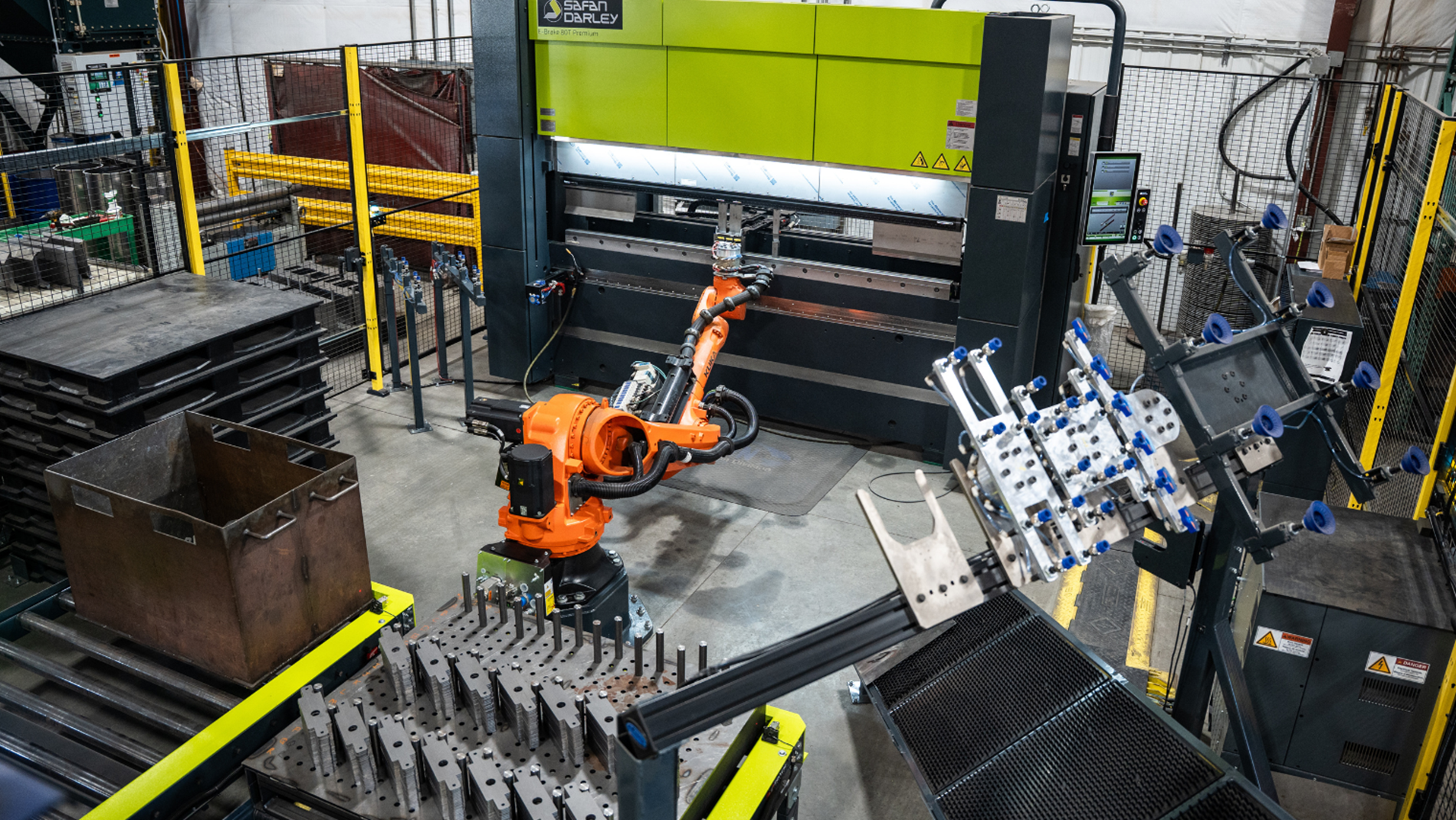
The Robotic Bending Cell is a turnkey solution from Gladwin, with a custom integration tailored for KWM Gutterman's production.
Pressing Forward With Automation
The machines KWM Gutterman produces are used by construction firms and suppliers to produce gutters in various sizes and profiles for modular installation on buildings, with the modularity used to customize the gutters to the building exterior.
“We do the majority of work in-house,” explains KWM Gutterman Fabrication Manager, John Young. “We start with laser and saw cutting for most of our parts, then move on to press brakes and attaching components. We also have a full-service CNC department producing rollers, mounting brackets and other components.” Once the company cuts, shapes and machines these components, workers assemble the machines and test them for quality control. Though the company began selling to local construction firms, it now sells to major construction suppliers with international footprints. “Domestically, our machines produce K-style, half-round, and semi-custom gutter profiles,” says Max Tucker, KWM Gutterman engineer. “But to be competitive, we offer several European style machines on top of our standard lineup for international demand.”
KWM Gutterman implemented KUKA robotic brake automation to increase output, improve worker safety, and simplify high-volume metal fabrication operations.
Automation Enables Innovation
“Due to consistent breakthroughs and innovation we’ve had to change our in-house processes,” Tucker explains. With increased production and more varied machines, the company had to find the most efficient path forward. That’s why the robotic press brake was a big step forward,” Tucker elaborates.
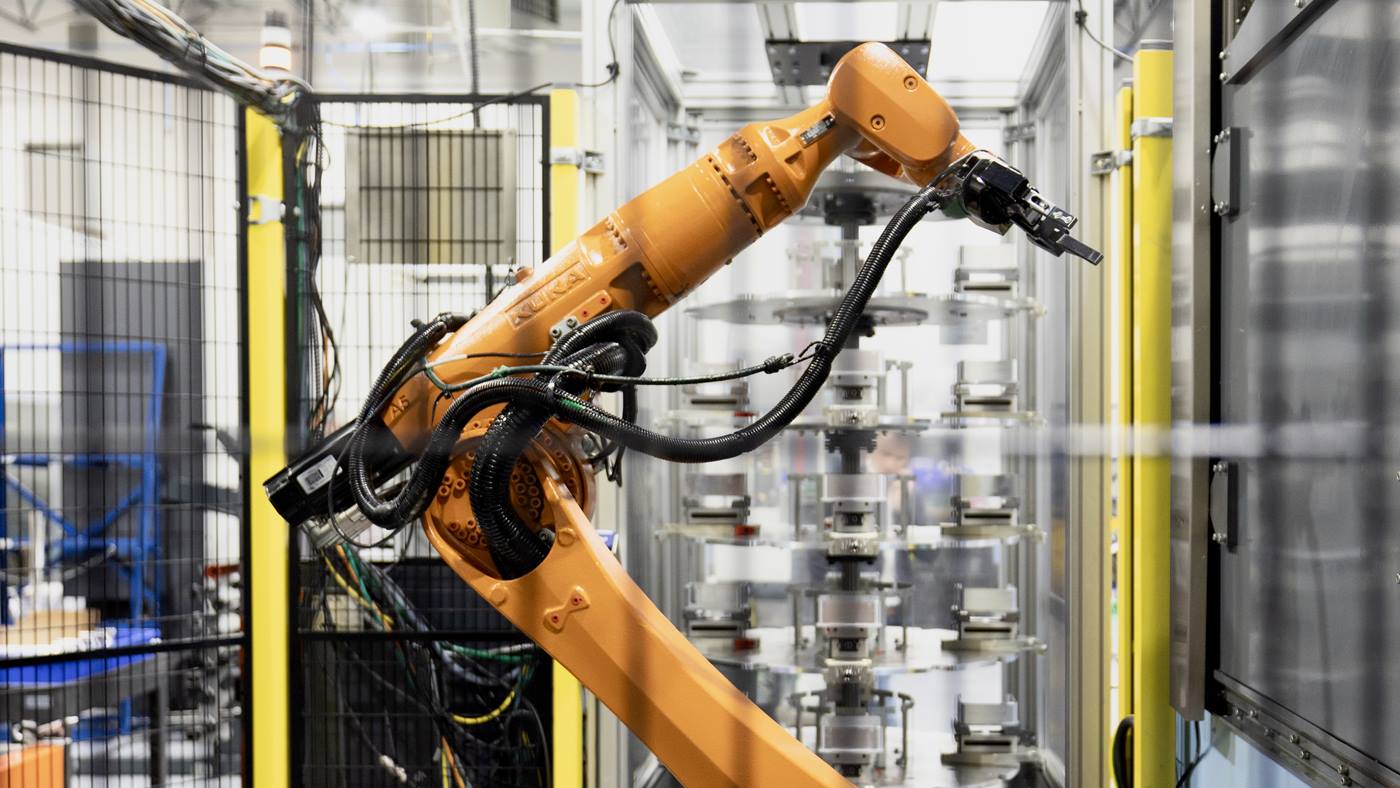
After investigating its options, KWM Gutterman purchased a Robotic Bending Cell (RBC) from Gladwin Machinery Solutions that uses a KUKA robot arm. The cell is a standard offering that incorporates KUKA’s KR 50 IONTEC industrial robot to operate the press brakes, taking advantage of the precision and flexibility of the robot to maneuver large parts into the orientations needed for proper forming.
The Gladwin cell integrated seamlessly into existing brake operations without disrupting upstream or downstream processes.
An Easy Solution for Automated Fabrication
As a standard solution designed for forming large parts, the RBC enabled the company to start producing parts as quickly as possible, avoiding the headache of designing an automation solution from scratch. “Some integrators were giving us a 28-week lead time to set up an automated cell,” Young notes. “This took maybe a week and a half, and we were up and running parts.”
Another draw to the RBC for KWM Gutterman was its overall ease of use for both beginner and expert operators. “Our press brake fabrication was never a highly automated operation before this,” Young mentions. “This was easy to learn and user-friendly, which made it the best fit for us.” Users can take advantage of simple dropdown menus and avoid having to dig through nested menus for an extended time. “You touch something, it pops up, and there are choices,” Young continues. “It might take a day to program, but the efficiencies and flexibility are worth it.”
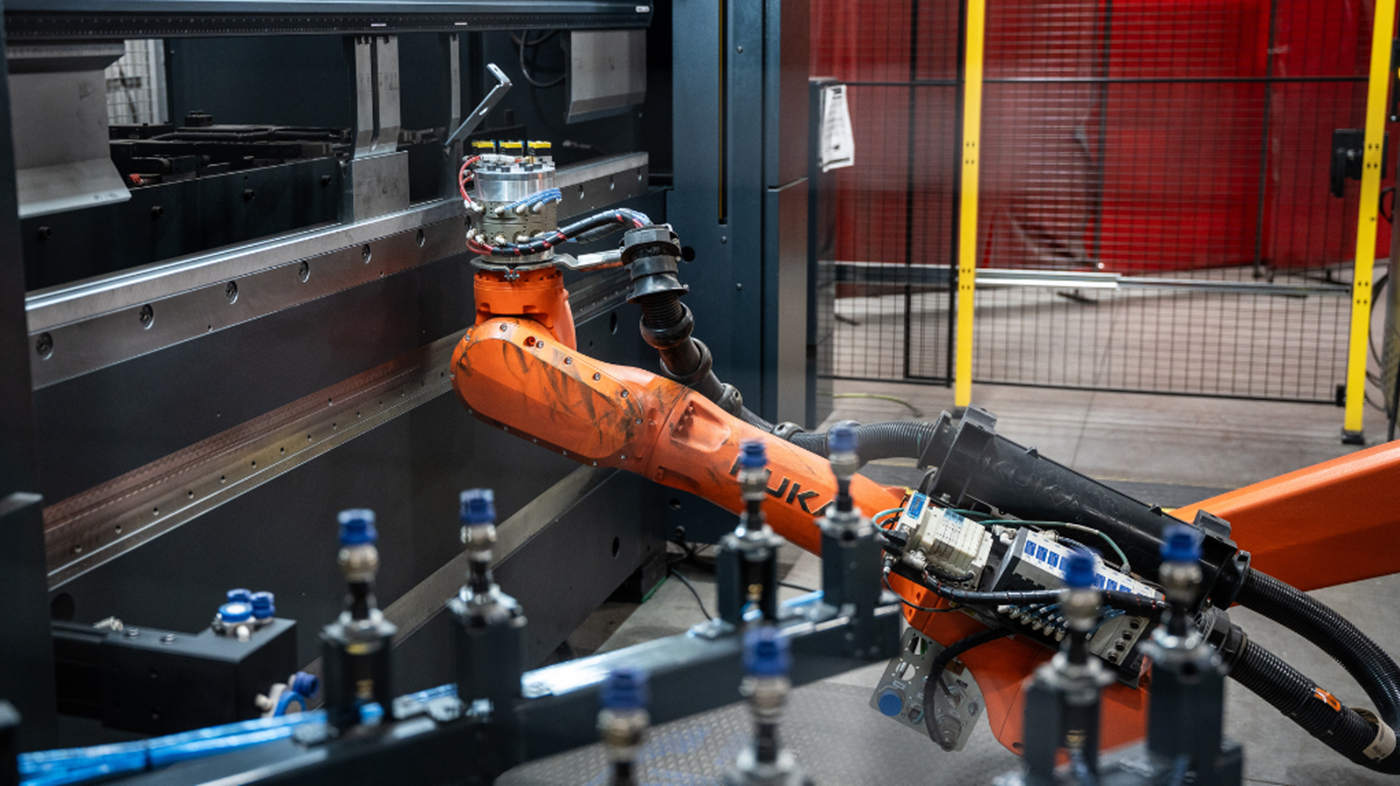
This KR IONTEC robot offers the right reach and payload capacity for the robotic bending cell.
One Solution, Many Benefits
Speaking of efficiencies, the increase in productivity has been a boon to KWM Gutterman. “Jobs that took two or three days are now taking only one day,” Young says. “We’ve even quadrupled production on some components.” The RBC has also enabled the shop to produce parts lights-out. “I can set up the robot at the end of the day, and when I come back the next day, the job is done,” Young adds.
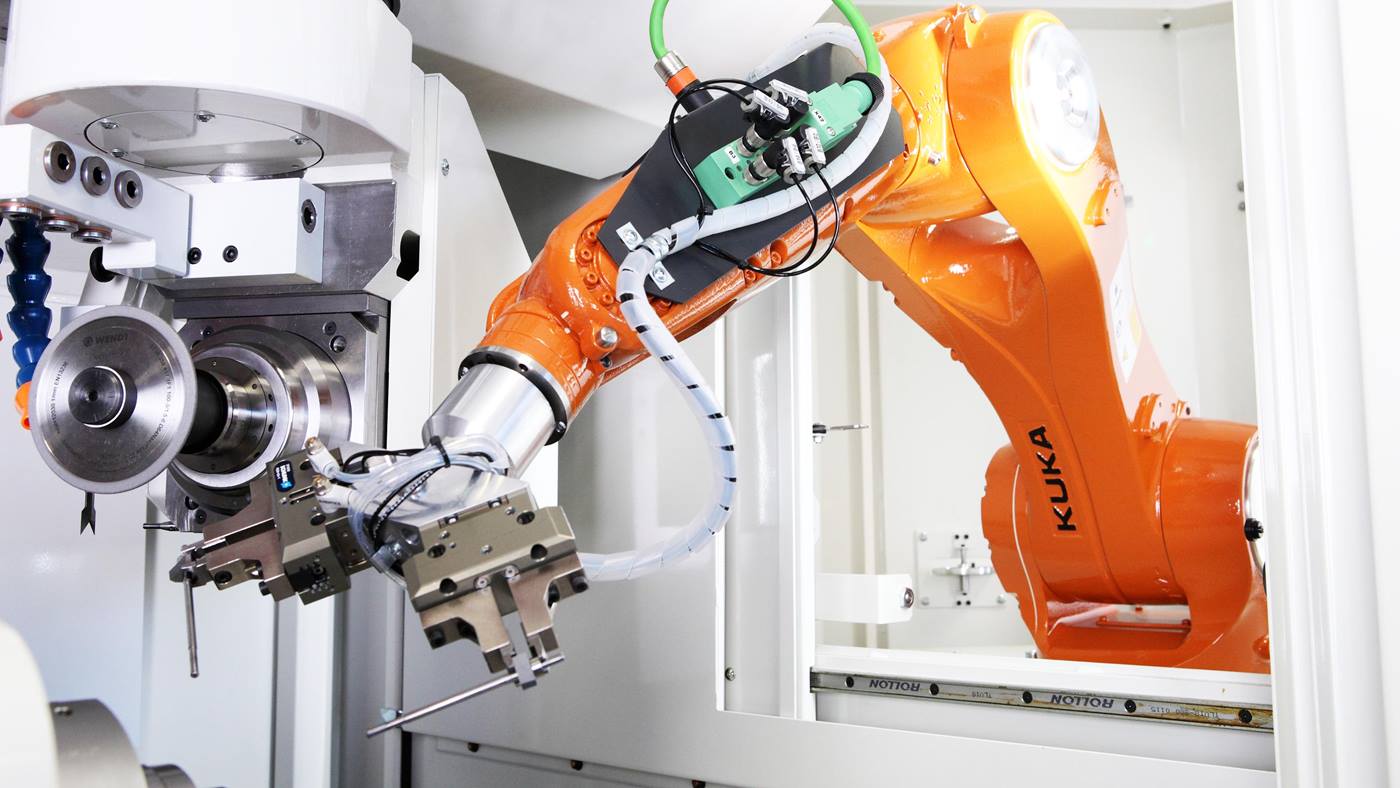
Robotic automation adapts to real-world metal fabrication challenges with consistent, physical execution.
The choice of automating the press brake was informed in part by the needs of labor. “People aren’t exactly lining up at the door to run a press brake,” Young shares. “Humans get fatigued because you’re holding a large, heavy workpiece into the machine for extended periods of time and at an exact orientation,” Young says. “So when someone’s standing there for eight hours, shoulders and forearms get tired.” The physical stress is a barrier to both hiring and keeping new workers, in addition to being a source of scrap. “At the end of a shift, the fatigue sets in and errors slowly creep into what you thought was a good part,” he continues. “With the RBC, parts are coming out with more consistency and precision.”
Gladwin provided universal bending routines based on the KUKA.UserTech software.
By replacing manual handling with robotic automation, KWM Gutterman improved throughput without expanding floor space or labor.
Empowering the Workforce
And while the automation has eased the labor pressure, it has not reduced the size of the team. “Our goal wasn’t to remove employees or take out anyone’s job,” Tucker says. “We’re not removing anyone. Labor is just shifting to where people are most needed.” This means employees who would have otherwise put their expertise to use moving large parts by hand can now focus on less physically demanding tasks while still making use of their experience.
While the benefits of automation have been palpable, KWM Gutterman has also been satisfied by the support provided by Gladwin Machinery Solutions. “Their part support is second to none,” Tucker says. “There’s no finger-pointing.” KUKA keeps a large stock of replacement parts in the U.S., and Gladwin works with the facility’s automation engineers to ensure they understand how problems can be avoided and repaired in the future. “Things go bad when lightning strikes,” Gladwin Machinery Solutions’ Automation Engineer Jack Leedy says. “We have to prepare so we can get the machine back up and running on the same day.”
At the end of the day, automating the press brakes has centered on reliability. By removing the need for manually placing workpieces in the press brakes, KWM Gutterman has reduced errors while dramatically increasing throughput, enabling lights-out production and freeing up workers to apply their skills where they’re needed most. This is how a company grows when skilled labor is in short supply.
Robotic handling ensures reliable positioning and repeatable quality in demanding metal fabrication applications.